Application
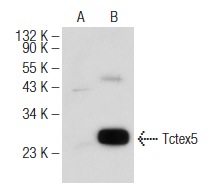
Western blot analysis of Tctex5 expression in non-transfected: (A) and mouse Tctex5 transfected: (B) 293T whole cell lysates.| Product Name | Tctex5 Antibody (FL-126) |
|---|---|
| Antibody Type | Primary Antibodies |
| Antigen Alias | epitope corresponding to amino acids 1-126 representing full length Tctex5 of human origin |
| Modification Notes | Tctex5, also known as PPP1R11 (protein phosphatase 1, regulatory (inhibitor) subunit 11), HCGV or TCTE5, is a 126 amino acid protein that is expressed in a variety of both adult and fetal tissues. Tctex5 functions as an inhibitor of PP1 (protein phosphatase 1), specifically exhibiting a sensitivity toward the metal-independent and metal-dependent forms of PP1. Sharing 87% sequence similarity with its mouse counterpart, Tctex5 is thought to be evolutionarily conserved throughout animal evolution, particularly between rat, cow, dog, rabbit and human. The gene encoding Tctex5 maps to human chromosome 6, which contains 170 million base pairs and comprises nearly 6% of the human genome. Deletion of a portion of the q arm of chromosome 6 is associated with early onset intestinal cancer, suggesting the presence of a cancer susceptibility locus. Additionally, Porphyria cutanea tarda, Parkinson's disease, Stickler syndrome and a susceptibility to bipolar disorder are all associated with genes that map to chromosome 6. |
| Clonality | Polyclonal |
|---|---|
| Isotype | IgG |
| Host Species | Rabbit |
| Tested Applications | WBIPIFELISA |
| recommended for detection of Tctex5 of mouse, rat and human origin by WB, IP, IF and ELISA also reactive with additional species, including equine, canine, bovine and porcine: |
|
| Species Reactivity | HumanMouseRat |
| Concentration | 1mg/ml |
| Purification | Affinity purified |
| Alternative Names | epitope corresponding to amino acids 1-126 representing full length Tctex5 of human origin |
|---|---|
| Tissue Specificity | epitope corresponding to amino acids 1-126 representing full length Tctex5 of human origin |
| Entrez Gene | 6992 |
|---|
Application
Western blot analysis of Tctex5 expression in non-transfected: (A) and mouse Tctex5 transfected: (B) 293T whole cell lysates.| Application Notes | recommended for detection of Tctex5 of mouse, rat and human origin by WB, IP, IF and ELISA also reactive with additional species, including equine, canine, bovine and porcine: |
|---|
| Form | Liquid |
|---|---|
| Storage Instructions | For short-term storage, store at 4° C. For long-term storage, aliquot and store at -20ºC or below. Avoid multiple freeze-thaw cycles. |
| Storage Buffer | phosphate buffered saline , pH 7.4, 150mM NaCl, 0.02% sodium azide and 50% glycerol. |


