Application
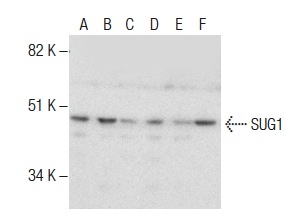
Western blot analysis of SUG1 expression in Hep G2 (A), LADMAC (B), HeLa (C), NIH/3T3 (D), A-431 (E) and Raji (F) whole cell lysates.| Product Name | SUG1 Antibody (H-64) |
|---|---|
| Antibody Type | Primary Antibodies |
| Antigen Alias | epitope corresponding to amino acids 89-152 mapping within an internal region of SUG1 of human origin |
| Modification Notes | The 26S proteasome is a highly ordered proteinase complex consisting of a 20S core and a 19S regulator. While the core is responsible for the proteolytic activity of the proteasome, the regulator contains several ATPase subunits which function in the ATP-dependent degradation of ubiquitinated proteins and confer substrate specificity to the 26S complex. SUG1, also known as PSMC5 (Proteasome 26S subunit ATPase 5), p45 or S8, is an ATPase subunit that is an integral part of the 26S proteasome complex. Localized to the cytoplasm and nucleus, SUG1 is part of the 19S regulator and functions in the ubiquitin/proteasome-mediated degradation of proteins (specifically receptors) found in the endoplasmic reticulum (ER). Recent studies suggest that assembly of the 26S proteasome is dependent upon phosphorylation of SUG1 by a protein kinase. In vitro, SUG1 also interacts with RXR (retinoid X receptor) and TR (thyroid hormone receptor), suggesting a possible role in transcriptional regulation. |
| Clonality | Polyclonal |
|---|---|
| Isotype | IgG |
| Host Species | Rabbit |
| Tested Applications | WBIPIFELISA |
| recommended for detection of SUG1 of mouse, rat and human origin by WB, IP, IF and ELISA also reactive with additional species, including equine, canine, bovine, porcine and avian: |
|
| Species Reactivity | HumanMouseRat |
| Concentration | 1mg/ml |
| Purification | Affinity purified |
| Alternative Names | epitope corresponding to amino acids 89-152 mapping within an internal region of SUG1 of human origin |
|---|---|
| Tissue Specificity | epitope corresponding to amino acids 89-152 mapping within an internal region of SUG1 of human origin |
| Entrez Gene | 5705 |
|---|
Application
Western blot analysis of SUG1 expression in Hep G2 (A), LADMAC (B), HeLa (C), NIH/3T3 (D), A-431 (E) and Raji (F) whole cell lysates.| Application Notes | recommended for detection of SUG1 of mouse, rat and human origin by WB, IP, IF and ELISA also reactive with additional species, including equine, canine, bovine, porcine and avian: |
|---|
| Form | Liquid |
|---|---|
| Storage Instructions | For short-term storage, store at 4° C. For long-term storage, aliquot and store at -20ºC or below. Avoid multiple freeze-thaw cycles. |
| Storage Buffer | phosphate buffered saline , pH 7.4, 150mM NaCl, 0.02% sodium azide and 50% glycerol. |


