Application
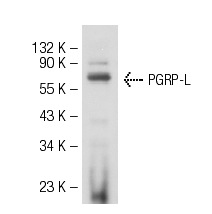
Western blot analysis of PGRP-L expression in mouse liver tissue extract.| Product Name | PGRP-L Antibody (H-300) |
|---|---|
| Antibody Type | Primary Antibodies |
| Antigen Alias | epitope corresponding to amino acids 22-321 mapping near the N-terminus of PGRP-L of human origin |
| Modification Notes | Peptidoglycan recognition protein-L (PGRP-L) is a pattern recognition molecule consisting of 576 amino acid residues. It is the longest and most widely expressed member of the PGRP family. PGRP-L is a Zn2+-dependent protein with N-acetylmuramyl-L-alanine-amidase activity that digests peptidoglycan. PGRP-L can form a homodimer and may dimerize with other PGRP proteins. It is a secreted serum protein but is also expressed as a transmembrane protein in liver parenchymal cells binding peptidoglycan and Gram-positive bacteria. PGRP-L deficient mice exhibit slightly lower levels of IL-6 and TNFå but exhibit no obvious phenotypic abnormalities. This suggests that PGRP-L may play a minor role in innate immune functions. In addition, PGRP-L may be a key player in the activation of Nod1, an intracellular pattern recognition protein. |
| Clonality | Polyclonal |
|---|---|
| Isotype | IgG |
| Host Species | Rabbit |
| Tested Applications | WBIPIFELISA |
| recommended for detection of PGRP-L of human and, to a lesser extent, mouse origin by WB, IP, IF and ELISA: |
|
| Species Reactivity | HumanMouseRat |
| Concentration | 1mg/ml |
| Purification | Affinity purified |
| Alternative Names | epitope corresponding to amino acids 22-321 mapping near the N-terminus of PGRP-L of human origin |
|---|---|
| Tissue Specificity | epitope corresponding to amino acids 22-321 mapping near the N-terminus of PGRP-L of human origin |
| Entrez Gene | 114770 |
|---|
Application
Western blot analysis of PGRP-L expression in mouse liver tissue extract.| Application Notes | recommended for detection of PGRP-L of human and, to a lesser extent, mouse origin by WB, IP, IF and ELISA: |
|---|
| Form | Liquid |
|---|---|
| Storage Instructions | For short-term storage, store at 4° C. For long-term storage, aliquot and store at -20ºC or below. Avoid multiple freeze-thaw cycles. |
| Storage Buffer | phosphate buffered saline , pH 7.4, 150mM NaCl, 0.02% sodium azide and 50% glycerol. |


