Application
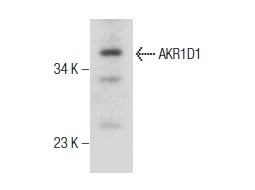
Western blot analysis of AKR1D1 expression in GA-10 whole cell lysate.| Product Name | AKR1D1 Antibody (H-70) |
|---|---|
| Antibody Type | Primary Antibodies |
| Antigen Alias | epitope corresponding to amino acids 198-267 mapping within an internal region of AKR1D1 of human origin |
| Modification Notes | AKR1D1 (aldo-keto reductase family 1 member D1), also known as Î(4)-3-oxosteroid 5-∫-reductase (3o5bred) or steroid 5-∫-reductase (SRD5B1), is responsible for catalyzing bile acid intermediates and steroid hormones possessing a Î(4)-3-one structure to 5-∫ reduced metabolites. The AKR family of proteins are soluble NADPH oxidoreductases. They play important roles in the metabolism of drugs, carcinogens and reactive aldehydes. AKR1D1 is highly expressed in liver, colon and testis. Substrates for AKR1D1 include testosterone, androstenedione, progesterone, 17-å-hydroxyprogesterone and the bile acid intermediates 7-å-hydroxy-4-cholesten-3-one and 7-å, 12-å-dihydroxy-4-cholesten-3-one. A deficiency in AKR1D1 may be involved in hepatic dysfunction. |
| Clonality | Polyclonal |
|---|---|
| Isotype | IgG |
| Host Species | Rabbit |
| Tested Applications | WBIPIFELISA |
| recommended for detection of AKR1D1 of mouse, rat and human origin by WB, IP, IF and ELISA also reactive with additional species, including equine, canine, bovine and porcine: |
|
| Species Reactivity | HumanMouseRat |
| Concentration | 1mg/ml |
| Purification | Affinity purified |
| Alternative Names | epitope corresponding to amino acids 198-267 mapping within an internal region of AKR1D1 of human origin |
|---|---|
| Tissue Specificity | epitope corresponding to amino acids 198-267 mapping within an internal region of AKR1D1 of human origin |
| Entrez Gene | 6718 |
|---|
Application
Western blot analysis of AKR1D1 expression in GA-10 whole cell lysate.| Application Notes | recommended for detection of AKR1D1 of mouse, rat and human origin by WB, IP, IF and ELISA also reactive with additional species, including equine, canine, bovine and porcine: |
|---|
| Form | Liquid |
|---|---|
| Storage Instructions | For short-term storage, store at 4° C. For long-term storage, aliquot and store at -20ºC or below. Avoid multiple freeze-thaw cycles. |
| Storage Buffer | phosphate buffered saline , pH 7.4, 150mM NaCl, 0.02% sodium azide and 50% glycerol. |


