Application
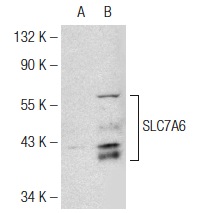
Western blot analysis of SLC7A6 expression in non-transfected: (A) and human SLC7A6 transfected: (B) 293T whole cell lysates.| Product Name | SLC7A6 Antibody (N-12) |
|---|---|
| Antibody Type | Primary Antibodies |
| Antigen Alias | epitope mapping within an N-terminal cytoplasmic domain of SLC7A6 of human origin |
| Modification Notes | SLC7A6 (solute carrier family 7 member 6), also known as LAT3, LAT-2 or y+LAT-2 (Y+L amino acid transporter 2), is a 515 amino acid multi-pass membrane protein belonging to the amino acid-polyamine-organocation (APC) superfamily and the L-type amino acid transporter (LAT) family. Expressed in normal fibroblasts, HUVECs (human umbilical vein endothelial cells), monocytes, RPE (retinal pigment epithelial) cells and various carcinoma cell lines, SLC7A6 is involved in the sodium-independent uptake of dibasic amino acids and sodium-dependent uptake of some neutral amino acids. SLC7A6 also acts as an arginine/glutamine exchanger, following an antiport mechanism for amino acid transport, influencing arginine release in exchange for extracellular amino acids. SLC7A6 may exist as a disulfide-linked heterodimer with the amino acid transport protein CD98. SLC7A6 plays a role in nitric oxide synthesis in HUVECs via transport of L-arginine, and is involved in the transport of L-arginine in monocytes and reduces uptake of ornithine in RPE cells. |
| Clonality | Polyclonal |
|---|---|
| Isotype | IgG |
| Host Species | Rabbit |
| Tested Applications | WBIPIFELISA |
| recommended for detection of SLC7A6 of human origin by WB, IP, IF and ELISA non cross-reactive with other SLC7A proteins: |
|
| Species Reactivity | HumanMouseRat |
| Concentration | 1mg/ml |
| Purification | Affinity purified |
| Alternative Names | epitope mapping within an N-terminal cytoplasmic domain of SLC7A6 of human origin |
|---|---|
| Tissue Specificity | epitope mapping within an N-terminal cytoplasmic domain of SLC7A6 of human origin |
| Entrez Gene | 9057 |
|---|
Application
Western blot analysis of SLC7A6 expression in non-transfected: (A) and human SLC7A6 transfected: (B) 293T whole cell lysates.| Application Notes | recommended for detection of SLC7A6 of human origin by WB, IP, IF and ELISA non cross-reactive with other SLC7A proteins: |
|---|
| Form | Liquid |
|---|---|
| Storage Instructions | For short-term storage, store at 4° C. For long-term storage, aliquot and store at -20ºC or below. Avoid multiple freeze-thaw cycles. |
| Storage Buffer | phosphate buffered saline , pH 7.4, 150mM NaCl, 0.02% sodium azide and 50% glycerol. |


