Application
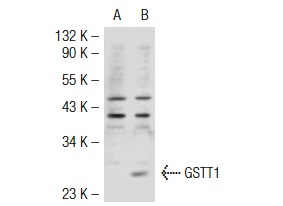
Western blot analysis of GSTT1 expression in non-transfected: (A) and mouse GSTT1 transfected: (B) 293T whole cell lysates.Application
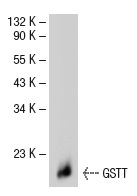
Western blot analysis of mouse liver tissue extract.| Product Name | GSTT Antibody (FL-240) |
|---|---|
| Antibody Type | Primary Antibodies |
| Antigen Alias | epitope corresponding to amino acids 1-240 representing full length GSTT1 of human origin |
| Modification Notes | The GST superfamily is made up of several subfamilies. Glutathione S-transferase P (GSTP1) belongs to the Pi subfamily and is involved in the conjugation of reduced glutathione to a variety of endogenous and exogenous hydrophobic electrophiles. Glutathione S-transferase Mu 1 (GSTM1) is a cytoplasmic liver protein belonging to the Mu family and has the same basic functions as GSTP1-1. Glutathione S-transferase theta 1 (GSTT1) is a cytoplasmic homodimer expressed in erythrocytes. It belongs to the Theta family. Aside from being active in the reduced glutathione conjugation, this protein displays glutathione peroxidase activity with cumene hydroperoxide. |
| Clonality | Polyclonal |
|---|---|
| Isotype | IgG |
| Host Species | Rabbit |
| Tested Applications | WBIPIFELISA |
| recommended for detection of Glutathione S-transferase Theta 1 and 3 and, to a lesser extent, GSTT2 of mouse, rat and human origin by WB, IP, IF and ELISA also reactive with additional species, including equine, canine, bovine and porcine: |
|
| Species Reactivity | HumanMouseRat |
| Concentration | 1mg/ml |
| Purification | Affinity purified |
| Alternative Names | epitope corresponding to amino acids 1-240 representing full length GSTT1 of human origin |
|---|---|
| Tissue Specificity | epitope corresponding to amino acids 1-240 representing full length GSTT1 of human origin |
| Entrez Gene | 2952 |
|---|
Application
Western blot analysis of GSTT1 expression in non-transfected: (A) and mouse GSTT1 transfected: (B) 293T whole cell lysates.
Application
Western blot analysis of mouse liver tissue extract.| Application Notes | recommended for detection of Glutathione S-transferase Theta 1 and 3 and, to a lesser extent, GSTT2 of mouse, rat and human origin by WB, IP, IF and ELISA also reactive with additional species, including equine, canine, bovine and porcine: |
|---|
| Form | Liquid |
|---|---|
| Storage Instructions | For short-term storage, store at 4° C. For long-term storage, aliquot and store at -20ºC or below. Avoid multiple freeze-thaw cycles. |
| Storage Buffer | phosphate buffered saline , pH 7.4, 150mM NaCl, 0.02% sodium azide and 50% glycerol. |


