Application
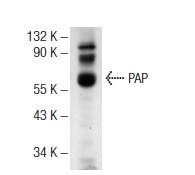
Western blot analysis of PAP expression in mouse testis tissue extract.Application
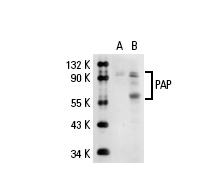
Western blot analysis of PAP expression in non-transfected: (A) and human PAP transfected: (B) 293 whole cell lysates.| Product Name | PAP Antibody (H-300) |
|---|---|
| Antibody Type | Primary Antibodies |
| Antigen Alias | epitope corresponding to amino acids 1-300 mapping at the N-terminus of PAP-α of human origin |
| Modification Notes | Polyadenylation of the 3-prime ends of eukaryotic mRNAs is a key event that takes place in the nucleus during maturation of mRNA. The reaction occurs in 2 distinct steps: endoribonucleolytic cleavage of the pre-RNA at the poly(A) site, followed by synthesis of the poly(A) tail at the 3-prime end of the upstream cleavage product. The poly(A) polymerase (PAP) is required for the adenosine addition reaction. Western blot analysis reveals three PAPs, demonstrating different molecular masses in HeLa cell extracts. The amino-terminal region of PAP is required for nonspecific polymerase activity, while both the amino and carboxy termini are required for specific polymerase activity. Additionally, PAP contains a functional ribonucleoprotein-type RNA binding domain (RBD) that is responsible for primer binding. The gene which encodes PAP maps to human chromosome 14q32.1-q32.2.. |
| Clonality | Polyclonal |
|---|---|
| Isotype | IgG |
| Host Species | Rabbit |
| Tested Applications | WBIPIFELISA |
| recommended for detection of all PAP isoforms of mouse, rat and human origin by WB, IP, IF and ELISA also reactive with additional species, including bovine, porcine and avian: |
|
| Species Reactivity | HumanMouseRat |
| Concentration | 1mg/ml |
| Purification | Affinity purified |
| Alternative Names | epitope corresponding to amino acids 1-300 mapping at the N-terminus of PAP-&alpha of human origin |
|---|---|
| Tissue Specificity | epitope corresponding to amino acids 1-300 mapping at the N-terminus of PAP-α of human origin |
| Entrez Gene | 10914 |
|---|
Application
Western blot analysis of PAP expression in mouse testis tissue extract.
Application
Western blot analysis of PAP expression in non-transfected: (A) and human PAP transfected: (B) 293 whole cell lysates.| Application Notes | recommended for detection of all PAP isoforms of mouse, rat and human origin by WB, IP, IF and ELISA also reactive with additional species, including bovine, porcine and avian: |
|---|
| Form | Liquid |
|---|---|
| Storage Instructions | For short-term storage, store at 4° C. For long-term storage, aliquot and store at -20ºC or below. Avoid multiple freeze-thaw cycles. |
| Storage Buffer | phosphate buffered saline , pH 7.4, 150mM NaCl, 0.02% sodium azide and 50% glycerol. |


