Application
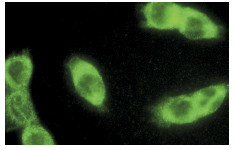
Immunofluorescence staining of methanol-fixed NIH/3T3 cells showing cytoplasmic localization.| Product Name | Clnk Antibody (M-300) |
|---|---|
| Antibody Type | Primary Antibodies |
| Antigen Alias | epitope corresponding to amino acids 1-300 mapping at the N-terminus of Clnk of mouse origin |
| Modification Notes | Adaptor proteins mediate the recruitment of positive or negative regulators into signaling networks, modulate effector function by allosteric regulation of enzymatic activity, and target other proteins for degradation in response to receptor ligation (1,2). Adaptor proteins can associate with numerous molecules and are required for coupling receptor ligation with more distal signaling events in immature thymocytes, mature T cells, platelets, and mast cells (2). The SLP-76 family of adaptor proteins are expressed exclusively in cytokine-stimulated hematopoietic cells (3). The SLP-76 family member Clnk, also designated MIST (mast cell immunoreceptor signal transducer) is structurally related to SLP-76 and BLNK/BASH/SLP-65 hematopoietic cell-specific adaptor proteins (4,5). The human Clnk gene maps to chromosome 4 and encodes a 376 amino acid protein (6). In activated T cells and myeloid cells, the serine/threonine-specific protein kinase HPK-1 can be recruited to macromolecular complexes through Clnk and cause immunoreceptor-mediated activation of the interleukin 2 (IL-2) promoter (3). |
| Clonality | Polyclonal |
|---|---|
| Isotype | IgG |
| Host Species | Rabbit |
| Tested Applications | WBIPIFELISA |
| recommended for detection of Clnk of mouse, rat and, to a lesser extent, human origin by WB, IP, IF and ELISA: |
|
| Species Reactivity | HumanMouseRat |
| Concentration | 1mg/ml |
| Purification | Affinity purified |
| Alternative Names | epitope corresponding to amino acids 1-300 mapping at the N-terminus of Clnk of mouse origin |
|---|---|
| Tissue Specificity | epitope corresponding to amino acids 1-300 mapping at the N-terminus of Clnk of mouse origin |
| Entrez Gene | 116449 |
|---|
Application
Immunofluorescence staining of methanol-fixed NIH/3T3 cells showing cytoplasmic localization.| Application Notes | recommended for detection of Clnk of mouse, rat and, to a lesser extent, human origin by WB, IP, IF and ELISA: |
|---|
| Form | Liquid |
|---|---|
| Storage Instructions | For short-term storage, store at 4° C. For long-term storage, aliquot and store at -20ºC or below. Avoid multiple freeze-thaw cycles. |
| Storage Buffer | phosphate buffered saline , pH 7.4, 150mM NaCl, 0.02% sodium azide and 50% glycerol. |


