Application
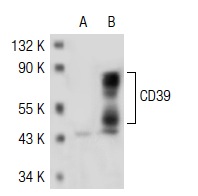
Western blot analysis of CD39 expression in non-transfected: (A) and mouse CD39 transfected: (B) 293T whole cell lysates.Application
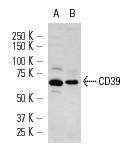
Western blot analysis of CD39 expression in rat (A) and mouse (B) placenta tissue extracts.| Product Name | CD39 Antibody (H-85) |
|---|---|
| Antibody Type | Primary Antibodies |
| Modification Notes | CD39, also known as ectonucleoside triphosphate diphosphohydrolase 1 (ENP1), is an integral membrane glycoprotein that acts as an extracellular nucleotide-hydrolyzing enzyme (1,2). CD39 inhibits ADP-induced platelet aggregation by hydrolyzing ADP to AMP and ultimately generating adenosine (3,4). Intracellular CD39 undergoes glycosylation at 6 N-glycosylation sites and translocates to the membrane in order to be an active enzyme (4). Alternative splicing gives rise to three CD39 isoforms, vascular, placenta I and placenta II (5). The placenta I isoform differs at the amino terminus whereas the placenta II isoform is missing amino acids 300-510 at the C-terminus (5). CD39 is expressed in vascular tissues including placenta, lung, skeletal muscle and kidney, as well as endothelium, smooth muscle, cardiac cells, lymphocytes (such as activated B cells) activated NK cells, macrophages, dendridic cells and platelets (1,3). CD39 may be used as an anti-thrombic agent for pre-treating patients at risk for coronary artery occlusion and thrombic stroke (6). |
| Clonality | Polyclonal |
|---|---|
| Isotype | IgG |
| Host Species | Rabbit |
| Tested Applications | WBIPIFELISA |
| recommended for detection of CD39 of mouse, rat and human origin by WB, IP, IF and ELISA | |
| Species Reactivity | HumanMouseRat |
| Concentration | 1mg/ml |
| Purification | Affinity purified |
| Alternative Names | epitope corresponding to amino acids 256-340 mapping within an internal region of CD39 of human origin |
|---|---|
| Tissue Specificity | epitope corresponding to amino acids 256-340 mapping within an internal region of CD39 of human origin |
| Entrez Gene | 953 |
|---|
Application
Western blot analysis of CD39 expression in non-transfected: (A) and mouse CD39 transfected: (B) 293T whole cell lysates.
Application
Western blot analysis of CD39 expression in rat (A) and mouse (B) placenta tissue extracts.| Application Notes | recommended for detection of CD39 of mouse, rat and human origin by WB, IP, IF and ELISA |
|---|
| Form | Liquid |
|---|---|
| Storage Instructions | For short-term storage, store at 4° C. For long-term storage, aliquot and store at -20ºC or below. Avoid multiple freeze-thaw cycles. |
| Storage Buffer | phosphate buffered saline , pH 7.4, 150mM NaCl, 0.02% sodium azide and 50% glycerol. |


