Application
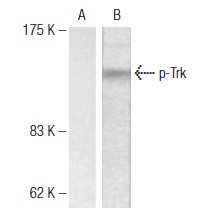
Blots were probed with p-Trk B (Tyr 706): preincubated with cognate phosphorylated peptide (A) and p-Trk B (Tyr 706): (B).| Product Name | p-Trk B Antibody (Tyr 706) |
|---|---|
| Antibody Type | Primary Antibodies |
| Antigen Alias | recommended for detection of Tyr 706 phosphorylated Trk B of human origin and correspondingly phosphorylated Tyr 705 of mouse and rat origin by WB and IP |
| Modification | Phosphoralated |
| Modification Notes | The Trk proto-oncogene encodes a tyrosine protein kinase, Trk A, also designated Trk gp140, that serves as a receptor for certain neurotrophic factors including nerve growth factor (NGF) and neurotrophin-3 (NT-3). Trk B is a tyrosine kinase gene highly related to Trk A. Trk B expression is confined to tissues within the central and peripheral nervous systems. The brain-derived neurotrophic factor (BDNF) and NT-3, but not NGF, can induce rapid phosphorylation on tyrosine of Trk B gp145, one of the receptors encoded by NTRK2, although BDNF elicits a response at least two orders of magnitude greater than NT-3. Thus it appears that Trk B gp145 may represent a neurotrophic receptor for BDNF and NT-3. The third member of the Trk family of tyrosine kinases, Trk C, encodes a protein designated Trk C gp145 that is preferentially expressed in brain tissue, is equally related to Trk A and Trk B and is a functional receptor for NT-3. Mouse, rat and human Trk B can be phosphorylated on five tyrosine residues, including Tyr 706, which allow substrate binding. |
| Clonality | Polyclonal |
|---|---|
| Isotype | IgG |
| Host Species | Rabbit |
| Tested Applications | WBIP |
| WB:1:500~1:2000 IP:1:100~1:500 Notes:Optimal dilutions/concentrations should be determined by the researcher. |
|
| Species Reactivity | HumanMouseRat |
| Concentration | 1mg/ml |
| Purification | Affinity purified |
| Alternative Names | recommended for detection of Tyr 706 phosphorylated Trk B of human origin and correspondingly phosphorylated Tyr 705 of mouse and rat origin by WB and IP |
|---|---|
| Tissue Specificity | recommended for detection of Tyr 706 phosphorylated Trk B of human origin and correspondingly phosphorylated Tyr 705 of mouse and rat origin by WB and IP |
| Entrez Gene | 4915 |
|---|
Application
Blots were probed with p-Trk B (Tyr 706): preincubated with cognate phosphorylated peptide (A) and p-Trk B (Tyr 706): (B).| Application Notes | WB:1:500~1:2000 IP:1:100~1:500 Notes:Optimal dilutions/concentrations should be determined by the researcher. |
|---|
| Form | Liquid |
|---|---|
| Storage Instructions | For short-term storage, store at 4° C. For long-term storage, aliquot and store at -20ºC or below. Avoid multiple freeze-thaw cycles. |
| Storage Buffer | phosphate buffered saline , pH 7.4, 150mM NaCl, 0.02% sodium azide and 50% glycerol. |


