Application
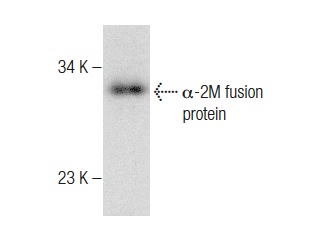
Western blot analysis of human recombinant α-2M fusion protein.| Product Name | α-2M Antibody (H-60) |
|---|---|
| Antibody Type | Primary Antibodies |
| Antigen Alias | epitope corresponding to amino acids 161-220 mapping near the N-terminus of α-2M of human origin |
| Modification Notes | å-2-Macroglobulin (å-2M) is a homotetrameric serum protein consisting of four identical subunits that form dimers through disulfide bonds. Initially, å-2M was characterized as a pan-proteinase inhibitor that was able to “bait” proteinases into cleaving specific peptide sequences on å-2M. This interaction induces a conformational change in å-2M, thus enabling it to “trap” the proteinase and further inhibit its activity. Subsequently, å-2M has been shown to function as a carrier protein and regulator of cytokines during inflammation. Circulating transforming growth factor ∫ (TGF∫) in serum is primarily bound to å-2M, which renders TGF∫ inactive. å-2M also binds to IL-6 and, thereby, increases the concentration of IL-6 near lymphocytes, hepatocytes and stem cells involved in mediating the inflammatory cascade. Mutations and deletions in the gene encoding å-2M are associated with an increased incidence of Alzheimer's Disease (AD), which is consistent with the role of å-2M in mediating the clearance and degradation of A ∫, the major component of ∫-Amyloid deposits accumulated during AD. |
| Clonality | Polyclonal |
|---|---|
| Isotype | IgG |
| Host Species | Rabbit |
| Tested Applications | WBIPIFELISA |
| recommended for detection of α-2M of mouse, rat and human origin by WB, IP, IF and ELISA also reactive with additional species, including canine: |
|
| Species Reactivity | HumanMouseRat |
| Concentration | 1mg/ml |
| Purification | Affinity purified |
| Alternative Names | epitope corresponding to amino acids 161-220 mapping near the N-terminus of &alpha -2M of human origin |
|---|---|
| Tissue Specificity | epitope corresponding to amino acids 161-220 mapping near the N-terminus of α-2M of human origin |
| Entrez Gene | 2 |
|---|
Application
Western blot analysis of human recombinant α-2M fusion protein.| Application Notes | recommended for detection of α-2M of mouse, rat and human origin by WB, IP, IF and ELISA also reactive with additional species, including canine: |
|---|
| Form | Liquid |
|---|---|
| Storage Instructions | For short-term storage, store at 4° C. For long-term storage, aliquot and store at -20ºC or below. Avoid multiple freeze-thaw cycles. |
| Storage Buffer | phosphate buffered saline , pH 7.4, 150mM NaCl, 0.02% sodium azide and 50% glycerol. |


