Application
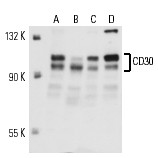
Western blot analysis of CD30 expression in MOLT-4 (A), HeLa (B), CCRF-CEM (C) and Jurkat (D) whole cell lysates.| Product Name | CD30 Antibody (H-180) |
|---|---|
| Antibody Type | Primary Antibodies |
| Antigen Alias | epitope corresponding to amino acids 416-595 mapping within a C-terminal cytoplasmic domain of CD30 of human origin |
| Modification Notes | The tumor necrosis factor (TNF) receptor family is composed of several type I integral membrane glycoproteins that exhibit homology in their cystine-rich extracellular domains. Members of this family include FAS, OX40, CD27 and CD30. Ligands for these receptors are often type II transmembrane glycoproteins, as is the case for CD27 and CD30. CD27 is a homodimeric lymphocyte-specific surface antigen present on T and B lymphocytes. Activation of the CD3 complex via the T cell receptor for antigen leads to an increase in CD27 expression. Together, CD27 and its ligand, CD27L, generate co-stimulatory signals required for complete T cell activation. CD30 is a surface marker for neoplastic cells of the Hodgkin’s lymphoma and related hematologic malignancies. CD30L has been shown to enhance the proliferation of the Hodgkin’s cell line HDLM-2, but exerts antiproliferative effects on large cell anaplastic lymphoma cell lines. |
| Clonality | Polyclonal |
|---|---|
| Isotype | IgG |
| Host Species | Rabbit |
| Tested Applications | WBIPIFELISA |
| recommended for detection of CD30 long and short forms of human and, to a lesser extent, mouse and rat origin by WB, IP, IF and ELISA: |
|
| Species Reactivity | HumanMouseRat |
| Concentration | 1mg/ml |
| Purification | Affinity purified |
| Alternative Names | epitope corresponding to amino acids 416-595 mapping within a C-terminal cytoplasmic domain of CD30 of human origin |
|---|---|
| Tissue Specificity | epitope corresponding to amino acids 416-595 mapping within a C-terminal cytoplasmic domain of CD30 of human origin |
| Entrez Gene | 943 |
|---|
Application
Western blot analysis of CD30 expression in MOLT-4 (A), HeLa (B), CCRF-CEM (C) and Jurkat (D) whole cell lysates.| Application Notes | recommended for detection of CD30 long and short forms of human and, to a lesser extent, mouse and rat origin by WB, IP, IF and ELISA: |
|---|
| Form | Liquid |
|---|---|
| Storage Instructions | For short-term storage, store at 4° C. For long-term storage, aliquot and store at -20ºC or below. Avoid multiple freeze-thaw cycles. |
| Storage Buffer | phosphate buffered saline , pH 7.4, 150mM NaCl, 0.02% sodium azide and 50% glycerol. |


