Application
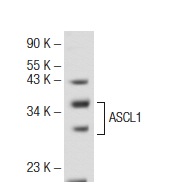
Western blot analysis of ASCL1 expression in C32 whole cell lysate.Application
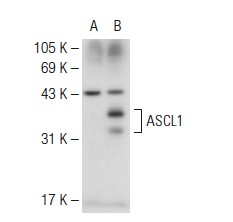
Western blot analysis of ASCL1 expression in non-transfected: (A) and human ASCL1 transfected: (B) 293T whole cell lysates.| Product Name | ASCL1 Antibody (H-56) |
|---|---|
| Antibody Type | Primary Antibodies |
| Antigen Alias | epitope corresponding to amino acids 181-236 mapping at the C-terminus of ASCL1 of human origin |
| Modification Notes | The mammalian homolog of the Drosophila protein achaete-scute, ASCL1 (also known as ASH1) is a basic helix-loop-helix transcription factor that is required for early development of the nervous system. Expressed in fetal brain, ASCL1 is essential for the proper development of autonomic neurons and for the survival of subsets of autonomic neurons. ASCL1 interaction with MEF-2A may regulate the expression of specific genes that are critical for the formation of distinct neuronal circuits within the central nervous system. The high level of ASCL1 expression in neuroendocrine tumors, such as medullary thyroid cancer, small cell lung cancer and lung cancer with neuroendocrine features may provide a useful marker for cancers with neuroendocrine features. Mapping to human chromosome 12, the ASCL1 gene contains a trinucleotide repeat region, making this locus a candidate for inherited disease. |
| Clonality | Polyclonal |
|---|---|
| Isotype | IgG |
| Host Species | Rabbit |
| Tested Applications | WBIPIFELISAGSChIP |
| recommended for detection of ASCL1 of mouse, rat and human origin by WB, IP, IF and ELISA also reactive with additional species, including equine, canine, bovine and avian: |
|
| Species Reactivity | HumanMouseRat |
| Concentration | 1mg/ml |
| Purification | Affinity purified |
| Alternative Names | epitope corresponding to amino acids 181-236 mapping at the C-terminus of ASCL1 of human origin |
|---|---|
| Tissue Specificity | epitope corresponding to amino acids 181-236 mapping at the C-terminus of ASCL1 of human origin |
| Entrez Gene | 429 |
|---|
Application
Western blot analysis of ASCL1 expression in C32 whole cell lysate.
Application
Western blot analysis of ASCL1 expression in non-transfected: (A) and human ASCL1 transfected: (B) 293T whole cell lysates.| Application Notes | recommended for detection of ASCL1 of mouse, rat and human origin by WB, IP, IF and ELISA also reactive with additional species, including equine, canine, bovine and avian: |
|---|
| Form | Liquid |
|---|---|
| Storage Instructions | For short-term storage, store at 4° C. For long-term storage, aliquot and store at -20ºC or below. Avoid multiple freeze-thaw cycles. |
| Storage Buffer | phosphate buffered saline , pH 7.4, 150mM NaCl, 0.02% sodium azide and 50% glycerol. |


