Application
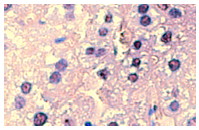
Immunoperoxidase staining of formalin-fixed, paraffin-embedded mouse liver tissue showing nuclear localization.Application
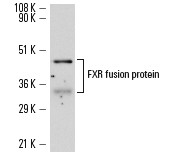
Western blot analysis of human recombinant FXR fusion protein.| Product Name | FXR Antibody (H-130) |
|---|---|
| Antibody Type | Primary Antibodies |
| Antigen Alias | epitope corresponding to amino acids 1-130 of FXR of human origin |
| Modification Notes | The steroid receptor superfamily acts through direct association with DNA sequences known as hormone response elements (HREs) and binds DNA as either homo- or heterodimers. The promiscuous mediator of heterodimerization, RXR, is the receptor for 9-cis retinoic acid, and dimerizes with VDR, TR, PPAR, and several novel receptors including LXR (also referred to as RLD-1) and FXR. FXR and LXR fall into a category of proteins termed “orphan receptors” because of their lack of a defined function, and in the case of LXR, the lack of a defined ligand. FXR has been shown to bind a class of lipid molecules called farnesoids. LXR/RXR heterodimers have highest affinity for DR-4 DNA elements while FXR/RXR heterodimers bind IR-1 elements. Both LXR/RXR and FXR/RXR heterodimers retain their responsiveness to 9-cis retinoic acid. |
| Clonality | Polyclonal |
|---|---|
| Isotype | IgG |
| Host Species | Rabbit |
| Tested Applications | WBIPIFIHCELISAGSChIP |
| recommended for detection of FXR of mouse, rat and human origin by WB, IP, IF, IHC(P) and ELISA also reactive with additional species, including bovine: |
|
| Species Reactivity | HumanMouseRat |
| Concentration | 1mg/ml |
| Purification | Affinity purified |
| Alternative Names | epitope corresponding to amino acids 1-130 of FXR of human origin |
|---|---|
| Tissue Specificity | epitope corresponding to amino acids 1-130 of FXR of human origin |
| Entrez Gene | 9971 |
|---|
Application
Immunoperoxidase staining of formalin-fixed, paraffin-embedded mouse liver tissue showing nuclear localization.
Application
Western blot analysis of human recombinant FXR fusion protein.| Application Notes | recommended for detection of FXR of mouse, rat and human origin by WB, IP, IF, IHC(P) and ELISA also reactive with additional species, including bovine: |
|---|
| Form | Liquid |
|---|---|
| Storage Instructions | For short-term storage, store at 4° C. For long-term storage, aliquot and store at -20ºC or below. Avoid multiple freeze-thaw cycles. |
| Storage Buffer | phosphate buffered saline , pH 7.4, 150mM NaCl, 0.02% sodium azide and 50% glycerol. |


