Application
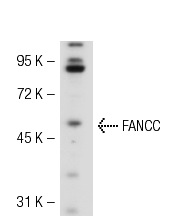
Western blot analysis of FANCC expression in HeLa whole cell lysate.| Product Name | FANCC Antibody (H-300) |
|---|---|
| Antibody Type | Primary Antibodies |
| Antigen Alias | epitope corresponding to amino acids 259-558 of FANCC of human origin |
| Modification Notes | Fanconi anemia (FA) is an autosomal recessive disorder characterized by bone marrow failure, birth defects and chromsomal instability (1,2). The FA Group C complementation group gene encodes the protein FANCC, which is located in both cytoplasmic and nuclear compartments. FANCC is expressed in a cell cycle-dependent manner, with the lowest levels at the G1/S boundary and the highest levels in the M-phase. The FANCC protein interacts with other FA complementation group proteins as well as non-FA proteins (3). A human a spectrin II (designated aSpIIs) acts as a scaffold to enhance interactions between FANCC and FANCA to form a nuclear complex (4,5). Another binding partner of FANCC is the BTB/POZ domain containing protein FAZF, which is a transcriptional repressor (6). In hematopoietic cells expressing mutant FANCC, PKR is constitutively phosphorylated and has increased binding affinity for double-stranded RNA (7,8), which suggests that FANCC indirectly suppresses the activity of PKR. These cells are also apoptotic and are hypersensitive to IFNg and TNFa (8). In addition, FANCC protein is involved in the activation of STAT1 through receptors for at least three hematopoietic growth and survival factors (8). |
| Clonality | Polyclonal |
|---|---|
| Isotype | IgG |
| Host Species | Rabbit |
| Tested Applications | WBIPIFELISA |
| recommended for detection of FANCC of human and, to a lesser extent, mouse and rat origin by WB, IP, IF and ELISA: |
|
| Species Reactivity | HumanMouseRat |
| Concentration | 1mg/ml |
| Purification | Affinity purified |
| Alternative Names | epitope corresponding to amino acids 259-558 of FANCC of human origin |
|---|---|
| Tissue Specificity | epitope corresponding to amino acids 259-558 of FANCC of human origin |
| Entrez Gene | 2176 |
|---|
Application
Western blot analysis of FANCC expression in HeLa whole cell lysate.| Application Notes | recommended for detection of FANCC of human and, to a lesser extent, mouse and rat origin by WB, IP, IF and ELISA: |
|---|
| Form | Liquid |
|---|---|
| Storage Instructions | For short-term storage, store at 4° C. For long-term storage, aliquot and store at -20ºC or below. Avoid multiple freeze-thaw cycles. |
| Storage Buffer | phosphate buffered saline , pH 7.4, 150mM NaCl, 0.02% sodium azide and 50% glycerol. |


