Application
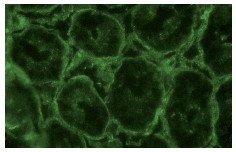
Immunofluor?escence staining of normal mouse intestine frozen section showing membrane staining.| Product Name | PSCA Antibody (M-70) |
|---|---|
| Antibody Type | Primary Antibodies |
| Antigen Alias | epitope corresponding to amino acids 21-90 mapping within an internal region of PSCA of mouse origin |
| Modification Notes | Prostate stem cell antigen (PSCA) is a 123 amino acid glycosylated protein that shares homology with the Thy-1/Ly-6 family of glycosyl-phosphatidylinositol (GPI)-anchored cell surface antigens. The PSCA gene maps to chromosome 8q24.3 and transcripts are most prevalent in prostate and placenta. The gene encoding c-myc is also located on chromosome 8q and like PSCA, is overexpressed in a large number of prostate cancers. Transcripts for PSCA are also abundant in urothelial tumors, and levels of PSCA transcripts increase in confluent RT112 bladder carcinomas, suggesting that PSCA is a marker for urothelial and gastric tissue carcinogenesis. Among prostate cancer cell surface antigens, PSCA is expressed in over 80% of prostate carcinomas and correlates well to certain prostate cancer phenotypes such as prostate cancer bone metastates. |
| Clonality | Polyclonal |
|---|---|
| Isotype | IgG |
| Host Species | Rabbit |
| Tested Applications | WBIPIFELISA |
| recommended for detection of precursor and mature forms of PSCA of mouse and rat origin by WB, IP, IF and ELISA: |
|
| Species Reactivity | HumanMouseRat |
| Concentration | 1mg/ml |
| Purification | Affinity purified |
| Alternative Names | epitope corresponding to amino acids 21-90 mapping within an internal region of PSCA of mouse origin |
|---|---|
| Tissue Specificity | epitope corresponding to amino acids 21-90 mapping within an internal region of PSCA of mouse origin |
| Entrez Gene | 72373 |
|---|
Application
Immunofluor?escence staining of normal mouse intestine frozen section showing membrane staining.| Application Notes | recommended for detection of precursor and mature forms of PSCA of mouse and rat origin by WB, IP, IF and ELISA: |
|---|
| Form | Liquid |
|---|---|
| Storage Instructions | For short-term storage, store at 4° C. For long-term storage, aliquot and store at -20ºC or below. Avoid multiple freeze-thaw cycles. |
| Storage Buffer | phosphate buffered saline , pH 7.4, 150mM NaCl, 0.02% sodium azide and 50% glycerol. |


