Application
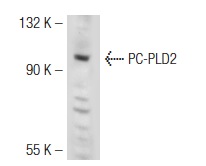
Western blot analysis of PC-PLD2 expression in U-937 whole cell lysate.| Product Name | PC-PLD2 Antibody (H-133) |
|---|---|
| Antibody Type | Primary Antibodies |
| Antigen Alias | epitope corresponding to amino acids 8-140 of PC-PLD2 of human origin |
| Modification Notes | Virtually every cell uses phosphatidylcholine as a substrate to produce phosphatidic acid and choline. Phosphatidylcholine phospholipase D1 and D2 (PC-PLD1 and PC-PLD2) are phospholipid-specific phosphodiesterases that hydrolyze phosphatidylcholine. Unlike PC-PLD1, which associates with secretory granules, PC-PLD2 localizes to the plasma membrane, where it is implicated in the formation of endocytotic vesicles. Both PC-PLD1 and PC-PLD2 coordinately regulate macrophage phagocytosis. PC-PLD activity in mammalian cells is transiently stimulated upon activation by G protein-coupled and receptor tyrosine kinase cell surface receptors. For example, PC-PLD1 and PC-PLD2 participate in sphingosine 1-phosphate stimulation of ERK phosphorylation and IL-8 secretion in bronchial epithelial cells. In addition, tubulin binding to PC-PLD2 inhibits muscarinic receptor-linked PC-PLD2 activation. PC-PLD2 also enhances PKCzeta activity through direct interaction in a lipase activity-independent manner. PC-PLD1 and PC-PLD2 stimulate cell growth by repressing expression of p21 gene through p53-dependent and p53-independent pathways, respectively, which may ultimately lead to carcinogenesis. |
| Clonality | Polyclonal |
|---|---|
| Isotype | IgG |
| Host Species | Rabbit |
| Tested Applications | WBIPIFELISA |
| recommended for detection of PC-PLD2 of mouse, rat and human origin by WB, IP, IF and ELISA also reactive with additional species, including equine, canine and bovine: |
|
| Species Reactivity | HumanMouseRat |
| Concentration | 1mg/ml |
| Purification | Affinity purified |
| Alternative Names | epitope corresponding to amino acids 8-140 of PC-PLD2 of human origin |
|---|---|
| Tissue Specificity | epitope corresponding to amino acids 8-140 of PC-PLD2 of human origin |
| Entrez Gene | 5338 |
|---|
Application
Western blot analysis of PC-PLD2 expression in U-937 whole cell lysate.| Application Notes | recommended for detection of PC-PLD2 of mouse, rat and human origin by WB, IP, IF and ELISA also reactive with additional species, including equine, canine and bovine: |
|---|
| Form | Liquid |
|---|---|
| Storage Instructions | For short-term storage, store at 4° C. For long-term storage, aliquot and store at -20ºC or below. Avoid multiple freeze-thaw cycles. |
| Storage Buffer | phosphate buffered saline , pH 7.4, 150mM NaCl, 0.02% sodium azide and 50% glycerol. |


