Application
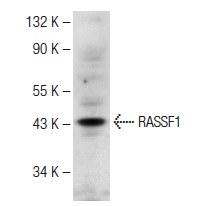
Western blot analysis of RASSF1 expression in MIA PaCa-2 whole cell lysate.| Product Name | RASSF1 Antibody (H-65) |
|---|---|
| Antibody Type | Primary Antibodies |
| Antigen Alias | epitope corresponding to amino acids 1-65 mapping at the N-terminus of RASSF1 isoform A of human origin |
| Modification Notes | Activated Ras proteins may induce senescence, apoptosis and terminal differentiation, though they are often associated with stimulating growth and transformation. The Ras association domain family 1 (RASSF1) gene is located at the human lung tumor suppressor locus 3p21.3. It consists of two major alternative transcripts, RASSF1A and RASSF1C. RASSF1 binds Ras in a GTP-dependent manner, both in vivo and in vitro. Activated Ras enhances and dominant negative Ras inhibits cell death induced by transient transfection of RASSF1 into 293-T cells, suggesting that RASSF1 tumor suppressor may serve as a Ras effector that mediates the apoptotic effects of oncogenic Ras. RASSF1A undergoes epigenetic inactivation in lung and breast cancers through hypermethylation of the CpG island of its promoter region. Mutant RASSF1A has significantly reduced growth suppression activity. Thus, RASSF1A is a potential tumor suppressor gene that plays an important role in a variety of tumor pathogenesis. |
| Clonality | Polyclonal |
|---|---|
| Isotype | IgG |
| Host Species | Rabbit |
| Tested Applications | WBIPIFELISA |
| recommended for detection of RASSF1A, RASSF1D, RASSF1E, RASSF1F and RASSF1G of mouse, rat and human origin by WB, IP, IF and ELISA also reactive with additional species, including equine: |
|
| Species Reactivity | HumanMouseRat |
| Concentration | 1mg/ml |
| Purification | Affinity purified |
| Alternative Names | epitope corresponding to amino acids 1-65 mapping at the N-terminus of RASSF1 isoform A of human origin |
|---|---|
| Tissue Specificity | epitope corresponding to amino acids 1-65 mapping at the N-terminus of RASSF1 isoform A of human origin |
| Entrez Gene | 11186 |
|---|
Application
Western blot analysis of RASSF1 expression in MIA PaCa-2 whole cell lysate.| Application Notes | recommended for detection of RASSF1A, RASSF1D, RASSF1E, RASSF1F and RASSF1G of mouse, rat and human origin by WB, IP, IF and ELISA also reactive with additional species, including equine: |
|---|
| Form | Liquid |
|---|---|
| Storage Instructions | For short-term storage, store at 4° C. For long-term storage, aliquot and store at -20ºC or below. Avoid multiple freeze-thaw cycles. |
| Storage Buffer | phosphate buffered saline , pH 7.4, 150mM NaCl, 0.02% sodium azide and 50% glycerol. |


