Application
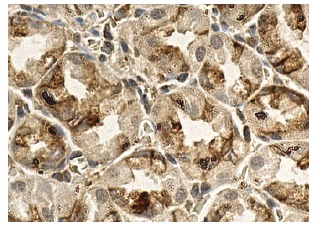
Immunoperoxidase staining of formalin fixed, paraffin-embedded human stomach tissue showing membrane and cytoplasmic staining of glandular cells.| Product Name | NHE-1 Antibody (H-160) |
|---|---|
| Antibody Type | Primary Antibodies |
| Antigen Alias | epitope corresponding to amino acids 656-815 mapping within a C-terminal cytoplasmic domain of NHE-1 of human origin |
| Modification Notes | Na+/H+ exchangers-1-–6 (Na+/H+ antiporters, NHE-1–6) are integral membrane proteins that are expressed in most mammalian tissues, where they regulate intracellular pH and cell volume. NHEs mediate the secondary active extrusion of hydrogen (H+) ions out of cells in exchange for extracellular sodium (Na+). Excluding NHE-1, which is ubiquitously expressed, the NHE isoforms (NHE-2–6 have distinct tissue- and cell type-dependent expression and inhibitory characteristics by amiloride analogs. Human NHE-1 protein, known also as solute carrier family 9 isoform-1, SLC9A1, is a ten transmembrane domain-spanning receptor that contains an N-terminal amphiphatic domain and two putative N-glycosylation sites. |
| Clonality | Polyclonal |
|---|---|
| Isotype | IgG |
| Host Species | Rabbit |
| Tested Applications | WBIPIFIHCELISA |
| recommended for detection of NHE-1 of mouse, rat and human origin by WB, IP, IF, IHC(P) and ELISA also reactive with additional species, including equine, canine, bovine and porcine: |
|
| Species Reactivity | HumanMouseRat |
| Concentration | 1mg/ml |
| Purification | Affinity purified |
| Alternative Names | epitope corresponding to amino acids 656-815 mapping within a C-terminal cytoplasmic domain of NHE-1 of human origin |
|---|---|
| Tissue Specificity | epitope corresponding to amino acids 656-815 mapping within a C-terminal cytoplasmic domain of NHE-1 of human origin |
| Entrez Gene | 6548 |
|---|
Application
Immunoperoxidase staining of formalin fixed, paraffin-embedded human stomach tissue showing membrane and cytoplasmic staining of glandular cells.| Application Notes | recommended for detection of NHE-1 of mouse, rat and human origin by WB, IP, IF, IHC(P) and ELISA also reactive with additional species, including equine, canine, bovine and porcine: |
|---|
| Form | Liquid |
|---|---|
| Storage Instructions | For short-term storage, store at 4° C. For long-term storage, aliquot and store at -20ºC or below. Avoid multiple freeze-thaw cycles. |
| Storage Buffer | phosphate buffered saline , pH 7.4, 150mM NaCl, 0.02% sodium azide and 50% glycerol. |


