Application
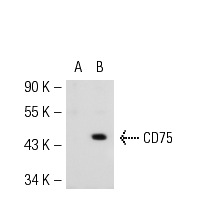
Western blot analysis of CD75 expression in non-transfected: (A) and human CD75 transfected: (B) 293T whole cell lysates.Application
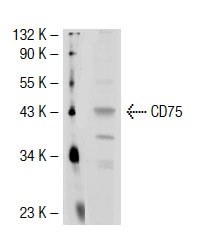
Western blot analysis of CD75 expression in HeLa whole cell lysate.| Product Name | CD75 Antibody (H-70) |
|---|---|
| Antibody Type | Primary Antibodies |
| Modification Notes | Modification of cell surface glycoprotein and glycolipid oligosaccharides is thought to play a role in tumorigenesis and metastasis. Sialyltransferases catalyze the incorporation of sialic acid into the carbohydrate chains present on glycoproteins and function in intracellular terminal glycosylation pathways. The expression of one such sialyltransferase, CD75, (also known as ST6GAL1), leads to the appearance of the cell surface antigens CD76, HB-6 and CDw75. Expressed in the golgi apparatus and secreted into the extracellular fluid, CD75 is a type II membrane protein that is involved in generating sialylated antigens that function as cell-surface carbohydrate determinants. One such antigen, CDw75 (also known as CD75s or CD75-sialyated), is formed via the catalytic transfer of a sialic acid residue from CD75 to a cell surface galactose-containing carbohydrate acceptor. While CD75 functions in cells throughout the body, CDw75 is found primarily on B and T cells and may be upregulated in B-cell leukemias, suggesting a possible role for CDw75 in carcinogenesis. |
| Clonality | Polyclonal |
|---|---|
| Isotype | IgG |
| Host Species | Rabbit |
| Tested Applications | WBIPIFELISA |
| recommended for detection of CD75 of mouse, rat and human origin by WB, IP, IF and ELISA also reactive with additional species, including equine, canine and porcine | |
| Species Reactivity | HumanMouseRat |
| Concentration | 1mg/ml |
| Purification | Affinity purified |
| Alternative Names | epitope corresponding to amino acids 111-180 of CD75 of human origin |
|---|---|
| Tissue Specificity | epitope corresponding to amino acids 111-180 of CD75 of human origin |
| Entrez Gene | 6480 |
|---|
Application
Western blot analysis of CD75 expression in non-transfected: (A) and human CD75 transfected: (B) 293T whole cell lysates.
Application
Western blot analysis of CD75 expression in HeLa whole cell lysate.| Application Notes | recommended for detection of CD75 of mouse, rat and human origin by WB, IP, IF and ELISA also reactive with additional species, including equine, canine and porcine |
|---|
| Form | Liquid |
|---|---|
| Storage Instructions | For short-term storage, store at 4° C. For long-term storage, aliquot and store at -20ºC or below. Avoid multiple freeze-thaw cycles. |
| Storage Buffer | phosphate buffered saline , pH 7.4, 150mM NaCl, 0.02% sodium azide and 50% glycerol. |


