Application
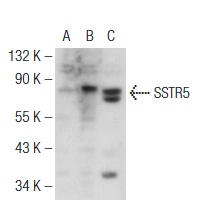
Western blot analysis of SSTR5 expression in non-transfected 293T: (A), human SSTR5 transfected 293T: (B) and HeLa (C) whole cell lysates.| Product Name | SSTR5 Antibody (H-54) |
|---|---|
| Antibody Type | Primary Antibodies |
| Modification Notes | SSTRs (for somatostatin receptors) represent a family of G-protein-coupled receptors which mediate the diverse biological actions of somatostatin (SST) (1). There are five distinct subtypes of SSTRs that bind two natural ligands, SST-14 and SST-28 (1). SSTR2 gives rise to spliced variants, SSTR2A and 2B (1). SSTRs share common signaling pathways such as the ability to inhibit adenylyl cyclase via GTP binding proteins (1-3). Some of the subtypes are also coupled to tyrosine phosphatase (SSTR1,2), Ca2+ channels (SSTR2), Na+/H+ exchanger (SSTR1), PLA-2 (SSTR4), and MAP kinase (SSTR4) (1). Individual target cells typically express more than one SSTR subtype and often all five isoforms (4,5). Subtypes of SSTR can form functional homo- and heterodimers (6,7). |
| Clonality | Polyclonal |
|---|---|
| Isotype | IgG |
| Host Species | Rabbit |
| Tested Applications | WBIPIFELISA |
| recommended for detection of SSTR5 of human and, to a lesser extent, mouse and rat origin by WB, IP, IF and ELISA | |
| Species Reactivity | HumanMouseRat |
| Concentration | 1mg/ml |
| Purification | Affinity purified |
| Alternative Names | epitope corresponding to amino acids 311-364 mapping to an internal region of SSTR5 of human origin |
|---|---|
| Tissue Specificity | epitope corresponding to amino acids 311-364 mapping to an internal region of SSTR5 of human origin |
| Entrez Gene | 6755 |
|---|
Application
Western blot analysis of SSTR5 expression in non-transfected 293T: (A), human SSTR5 transfected 293T: (B) and HeLa (C) whole cell lysates.| Application Notes | recommended for detection of SSTR5 of human and, to a lesser extent, mouse and rat origin by WB, IP, IF and ELISA |
|---|
| Form | Liquid |
|---|---|
| Storage Instructions | For short-term storage, store at 4° C. For long-term storage, aliquot and store at -20ºC or below. Avoid multiple freeze-thaw cycles. |
| Storage Buffer | phosphate buffered saline , pH 7.4, 150mM NaCl, 0.02% sodium azide and 50% glycerol. |


