Application
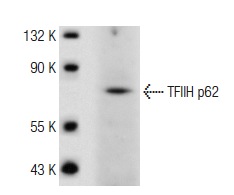
Western blot analysis of TFIIH p62 expression in A549 nuclear extract.Application
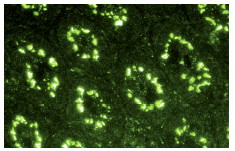
Immunofluorescence staining of normal mouse intestine frozen section showing nuclear staining.| Product Name | TFIIH p62 Antibody (H-300) |
|---|---|
| Antibody Type | Primary Antibodies |
| Antigen Alias | epitope corresponding to amino acids 249-548 mapping at the C-terminus of TFIIH p62 of human origin |
| Modification Notes | Initiation of transcription from protein-coding genes in eukaryotes is a complex process that requires RNA polymerase II, as well as families of basal transcription factors (1). Binding of the factor TFIID (TBP) to the TATA box is believed to be the first step in the formation of a multiprotein complex containing several additional factors, including TFIIA, TFIIB, TFIIE, TFIIF and TFIIH (1–3). TFIIH (or BTF2) is a multisubunit transcription/DNA repair factor that possesses several enzymatic activities (4). The core of TFIIH is composed of 5 subunits, designated p89 (XPB or ERCC3) (5), p62 (6), p52 (4), p44 and p34 (7). Additional subunits of the TFIIH complex are p80 (XPD or ERCC2) (8) and the ternary kinase complex composed of Cdk7, cyclin H and MAT1 (4). Both p89 and p80 have ATP-dependent helicase activity (5,8). The p62, p52 and p44 subunits have been shown to be involved in nucleotide excision repair (4,6,7). |
| Clonality | Polyclonal |
|---|---|
| Isotype | IgG |
| Host Species | Rabbit |
| Tested Applications | WBIPIFELISAGSChIP |
| recommended for detection of TFIIH p62 of mouse, rat and human origin by WB, IP, IF and ELISA also reactive with additional species, including equine, canine, bovine and porcine: |
|
| Species Reactivity | HumanMouseRat |
| Concentration | 1mg/ml |
| Purification | Affinity purified |
| Alternative Names | epitope corresponding to amino acids 249-548 mapping at the C-terminus of TFIIH p62 of human origin |
|---|---|
| Tissue Specificity | epitope corresponding to amino acids 249-548 mapping at the C-terminus of TFIIH p62 of human origin |
| Entrez Gene | 2965 |
|---|
Application
Western blot analysis of TFIIH p62 expression in A549 nuclear extract.
Application
Immunofluorescence staining of normal mouse intestine frozen section showing nuclear staining.| Application Notes | recommended for detection of TFIIH p62 of mouse, rat and human origin by WB, IP, IF and ELISA also reactive with additional species, including equine, canine, bovine and porcine: |
|---|
| Form | Liquid |
|---|---|
| Storage Instructions | For short-term storage, store at 4° C. For long-term storage, aliquot and store at -20ºC or below. Avoid multiple freeze-thaw cycles. |
| Storage Buffer | phosphate buffered saline , pH 7.4, 150mM NaCl, 0.02% sodium azide and 50% glycerol. |


