Application
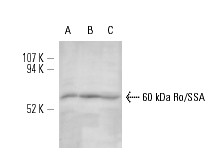
Western blot analysis of 60 kDa Ro/SSA expression in HeLa (A), MCF7 (B) and A549 (C) whole cell lysates.| Product Name | 60 kDa Ro/SSA Antibody (H-300) |
|---|---|
| Antibody Type | Primary Antibodies |
| Modification Notes | Ro autoantigens are of clinical significance because antibodies directed against them are found in most patients with primary Sjögren syndrome, subacute cutaneous lupus erythematosus (SLE), neonatal lupus erythematosus, ANA-negative lupus erythematosus, and systemic lupus erythematosus-like disease secondary to homozygous C2 or C4 complement deficiency (1). Ro/SSA is a ribonucleoprotein that binds to autoantibodies in 35 to 50% of patients with SLE and in up to 97% of patients with Sjögren syndrome (2). The Ro/SSA particle consists of a single immunoreactive protein noncovalently bound with one of four small RNA molecules (2). Most anti-Ro/SSA-positive sera antibodies detect not only the main protein, but also a smaller Ro/SSA protein (2). The genes which encode the smaller and larger proteins map to human chromosomes 11p15.5 and 1q31, respectively (3–5). La/SSB is an autoimmune RNA-binding protein that plays a role in the transcription of RNA polymerase III was originally defined by its reactivity with autoantibodies from patients with Sjögren syndrome and SLE (6). |
| Clonality | Polyclonal |
|---|---|
| Isotype | IgG |
| Host Species | Rabbit |
| Tested Applications | WBIPIFELISA |
| recommended for detection of 60 kDa Ro/SSA of mouse, rat and human origin by WB, IP, IF and ELISA also reactive with additional species, including equine, canine, bovine and porcine | |
| Species Reactivity | HumanMouseRat |
| Concentration | 1mg/ml |
| Purification | Affinity purified |
| Alternative Names | epitope corresponding to amino acids 239-538 of 60 kDa Ro/SSA of human origin |
|---|---|
| Tissue Specificity | epitope corresponding to amino acids 239-538 of 60 kDa Ro/SSA of human origin |
| Entrez Gene | 6738 |
|---|
Application
Western blot analysis of 60 kDa Ro/SSA expression in HeLa (A), MCF7 (B) and A549 (C) whole cell lysates.| Application Notes | recommended for detection of 60 kDa Ro/SSA of mouse, rat and human origin by WB, IP, IF and ELISA also reactive with additional species, including equine, canine, bovine and porcine |
|---|
| Form | Liquid |
|---|---|
| Storage Instructions | For short-term storage, store at 4° C. For long-term storage, aliquot and store at -20ºC or below. Avoid multiple freeze-thaw cycles. |
| Storage Buffer | phosphate buffered saline , pH 7.4, 150mM NaCl, 0.02% sodium azide and 50% glycerol. |


