Application
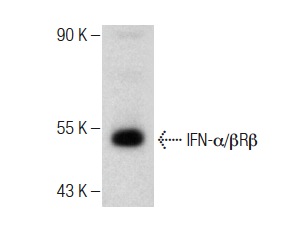
Western blot analysis of IFN-α/βRβ expression in K-562 whole cell lysate.| Product Name | IFN-α/βRβ Antibody (C-18) |
|---|---|
| Antibody Type | Primary Antibodies |
| Modification Notes | The type I interferons, IFN-α and IFN-β, are a group of structurally and functionally related proteins that are induced by either viruses or double-stranded RNA and are defined by their ability to confer an antiviral state in cells. IFN-α and IFN-βappear to compete with one another for binding to a common cell surface receptor, while immune IFN (IFN-γ) binds to a distinct receptor. This distinct receptor, IFN-αR, is only weakly responsive to type I interferons, in contrast to IFN-α/βR, which binds to and responds effectively to IFN-β and to several of the IFN-α subtypes. IFN-α/βR is expressed as two alternatively spliced transcripts, designated IFN-α/βRα (IFN-α/βR1) and IFN-α/βRβ (IFN-α/βR2), both of which are involved in signal transduction and ligand binding. |
| Clonality | Polyclonal |
|---|---|
| Isotype | IgG |
| Host Species | Rabbit |
| Tested Applications | WBIPIFELISA |
| recommended for detection of IFN-&alpha/&betaR beta chain of human origin by WB, IP, IF and ELISA | |
| Species Reactivity | HumanMouseRat |
| Concentration | 1mg/ml |
| Purification | Affinity purified |
| Alternative Names | epitope mapping at the C-terminus of IFN-&alpha /&beta R&beta of human origin |
|---|---|
| Tissue Specificity | epitope mapping at the C-terminus of IFN-α/βRβ of human origin |
| Entrez Gene | 3455 |
|---|
Application
Western blot analysis of IFN-α/βRβ expression in K-562 whole cell lysate.| Application Notes | recommended for detection of IFN-&alpha/&betaR beta chain of human origin by WB, IP, IF and ELISA |
|---|
| Form | Liquid |
|---|---|
| Storage Instructions | For short-term storage, store at 4° C. For long-term storage, aliquot and store at -20ºC or below. Avoid multiple freeze-thaw cycles. |
| Storage Buffer | phosphate buffered saline , pH 7.4, 150mM NaCl, 0.02% sodium azide and 50% glycerol. |


