Application
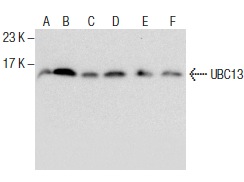
Western blot analysis of UBC13 expression in BJAB (A), CCRF-CEM (B), Jurkat (C), Hep G2 (D), C6 (E) and NIH/3T3 (F) whole cell lysates.| Product Name | UBC13 Antibody (H-75) |
|---|---|
| Antibody Type | Primary Antibodies |
| Modification Notes | Ubiquitination is an important mechanism through which three classes of enzymes act in concert to target short-lived or abnormal proteins for destruction. The three classes of enzymes involved in ubiquitination are the ubiquitin-activating enzymes (E1s), the ubiquitin-conjugating enzymes (E2s) and the ubiquitin-protein ligases (E3s). UBC13, also known as UBE2N or BLU, is a 152 amino acid member of the E2 ubiquitin-conjugating enzyme family. Existing as a heterodimer with Mms2 (also known as UBE2V2), UBC13 catalyzes the ATP-dependent synthesis of non-canonical polyubiquitin chains, a process that does not lead to proteasomal degradation. Additionally, UBC13 mediates the transcription of several target genes and is thought to play a role in cell cycle progression, cellular differentiation and DNA repair mechanisms that ensure cell survival after DNA damage. |
| Clonality | Polyclonal |
|---|---|
| Isotype | IgG |
| Host Species | Rabbit |
| Tested Applications | WBIPIFELISA |
| recommended for detection of UBC13 of mouse, rat and human origin by WB, IP, IF and ELISA also reactive with additional species, including equine, canine, bovine, porcine and avian | |
| Species Reactivity | HumanMouseRat |
| Concentration | 1mg/ml |
| Purification | Affinity purified |
| Alternative Names | epitope corresponding to amino acids 1-75 mapping at the N-terminus of UBC13 of human origin |
|---|---|
| Tissue Specificity | epitope corresponding to amino acids 1-75 mapping at the N-terminus of UBC13 of human origin |
| Entrez Gene | 7334 |
|---|
Application
Western blot analysis of UBC13 expression in BJAB (A), CCRF-CEM (B), Jurkat (C), Hep G2 (D), C6 (E) and NIH/3T3 (F) whole cell lysates.| Application Notes | recommended for detection of UBC13 of mouse, rat and human origin by WB, IP, IF and ELISA also reactive with additional species, including equine, canine, bovine, porcine and avian |
|---|
| Form | Liquid |
|---|---|
| Storage Instructions | For short-term storage, store at 4° C. For long-term storage, aliquot and store at -20ºC or below. Avoid multiple freeze-thaw cycles. |
| Storage Buffer | phosphate buffered saline , pH 7.4, 150mM NaCl, 0.02% sodium azide and 50% glycerol. |


