Application
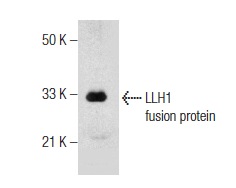
Western blot analysis of human recombinant LLH1 fusion protein.| Product Name | LLH1 Antibody (H-40) |
|---|---|
| Antibody Type | Primary Antibodies |
| Antigen Alias | epitope corresponding to amino acids 254-293 mapping within an internal region of LLH1 of human origin |
| Modification Notes | Lysyl hydroxylases (LLHs) 1-3 are hydroxylysines that function as attachment sites for carbohydrates. In collagen, the LLHs form hydroxylysine residues in -Xaa-Lys-Gly- sequences and are crucial for collagen cross-link stability. They form homodimers that localize to the endoplasmic reticulum. LLH1 is strongly expressed in liver, heart, lung, skeletal muscle and kidney tissue. LLH2 is highly expressed in heart, lung, kidney, eye, ovary and placenta, whereas LLH3 is expressed mainly in heart, lung, liver and testis. LLH1 preferentially hydroxylates triple helical lysine residues at the cross-link positions. Decreased levels of LLH1 expression may lead to Ehlers-Danlos syndrome type VI in skin fibroblasts. This syndrome refers to a heterogeneous group of inherited connective tissue disorders that are characterized by joint hypermobility, skin fragility and hyperextensibility. |
| Clonality | Polyclonal |
|---|---|
| Isotype | IgG |
| Host Species | Rabbit |
| Tested Applications | WBIPIFELISA |
| recommended for detection of LLH1 of mouse, rat and human origin by WB, IP, IF and ELISA also reactive with additional species, including equine, canine, bovine and porcine: |
|
| Species Reactivity | HumanMouseRat |
| Concentration | 1mg/ml |
| Purification | Affinity purified |
| Alternative Names | epitope corresponding to amino acids 254-293 mapping within an internal region of LLH1 of human origin |
|---|---|
| Tissue Specificity | epitope corresponding to amino acids 254-293 mapping within an internal region of LLH1 of human origin |
| Entrez Gene | 5351 |
|---|
Application
Western blot analysis of human recombinant LLH1 fusion protein.| Application Notes | recommended for detection of LLH1 of mouse, rat and human origin by WB, IP, IF and ELISA also reactive with additional species, including equine, canine, bovine and porcine: |
|---|
| Form | Liquid |
|---|---|
| Storage Instructions | For short-term storage, store at 4° C. For long-term storage, aliquot and store at -20ºC or below. Avoid multiple freeze-thaw cycles. |
| Storage Buffer | phosphate buffered saline , pH 7.4, 150mM NaCl, 0.02% sodium azide and 50% glycerol. |


