Application
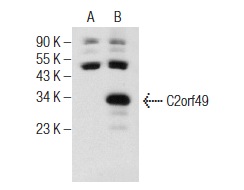
Western blot analysis of C2orf49 expression in non-transfected: (A) and human C2orf49 transfected: (B) 293T whole cell lysates.| Product Name | C2orf49 Antibody (P-13) |
|---|---|
| Antibody Type | Primary Antibodies |
| Modification Notes | C2orf49 (chromosome 2 open reading frame 49), also known as asw, Ashwin, MGC5509 or FLJ45759, is a 232 amino acid member of the ashwin family and is encoded by a gene located on human chromosome 2q12.2. The second largest human chromosome, chromosome 2 consists of 237 million bases encoding over 1,400 genes and making up approximately 8% of the human genome. A number of genetic diseases are linked to genes on chromosome 2. Harlequin icthyosis, a rare and morbid skin deformity, is associated with mutations in the ABCA12 gene. The lipid metabolic disorder sitosterolemia is associated with ABCG5 and ABCG8. An extremely rare recessive genetic disorder, Alström syndrome is due to mutations in the ALMS1 gene. Interestingly, chromosome 2 contains what appears to be a vestigial second centromere and vestigial telomeres which gives credence to the hypothesis that human chromosome 2 is the result of an ancient fusion of two ancestral chromosomes seen in modern form today in apes. |
| Clonality | Polyclonal |
|---|---|
| Isotype | IgG |
| Host Species | Rabbit |
| Tested Applications | WBIPIFELISA |
| recommended for detection of C2orf49 of human origin, AI597479 of mouse origin and the corresponding rat homolog by WB, IP, IF and ELISA non cross-reactive with other C2orf family members also reactive with additional species, including equine, canine, porcine and avian | |
| Species Reactivity | HumanMouseRat |
| Concentration | 1mg/ml |
| Purification | Affinity purified |
| Alternative Names | epitope mapping within an internal region of C2orf49 of human origin |
|---|---|
| Tissue Specificity | epitope mapping within an internal region of C2orf49 of human origin |
| Entrez Gene | 79074 |
|---|
Application
Western blot analysis of C2orf49 expression in non-transfected: (A) and human C2orf49 transfected: (B) 293T whole cell lysates.| Application Notes | recommended for detection of C2orf49 of human origin, AI597479 of mouse origin and the corresponding rat homolog by WB, IP, IF and ELISA non cross-reactive with other C2orf family members also reactive with additional species, including equine, canine, porcine and avian |
|---|
| Form | Liquid |
|---|---|
| Storage Instructions | For short-term storage, store at 4° C. For long-term storage, aliquot and store at -20ºC or below. Avoid multiple freeze-thaw cycles. |
| Storage Buffer | phosphate buffered saline , pH 7.4, 150mM NaCl, 0.02% sodium azide and 50% glycerol. |


