Application
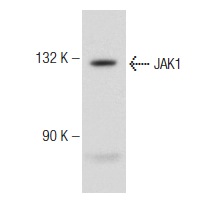
Western blot analysis of JAK1 expression in Jurkat whole cell lysate.| Product Name | JAK1 Antibody (Q-19) |
|---|---|
| Antibody Type | Primary Antibodies |
| Modification Notes | Jak1 (Janus kinase 1) belongs to the family of non-receptor janus tyrosine kinases, which regulate a spectrum of cellular functions downstream of activated cytokine receptors in the lympho-hematopoietic system. Immunological stimuli, such as interferons and cytokines, induce recruitment of STAT transcription factors to cytokine receptor-associated Jak1. Jak1 then phosphorylates proximal STAT factors, which subsequently dimerize, translocate to the nucleus and bind to cis elements upstream of target gene promoters to regulate transcription. Upon ligand binding, Jak1 undergoes tyrosine phosphorylation and catalytic activation in an interdependent manner. Phosphorylation of tyrosine residues at position 1022 and 1023 is believed to function in the activation of catalytic events. The canonical Jak-STAT pathway is integral to maintaining a normal immune system by stimulating proliferation, differentiation, survival, and host resistance to pathogens. Altering Jak-STAT signaling to reduce cytokine induced pro-inflammatory responses represents an attractive target for anti-inflammatory therapies. |
| Clonality | Polyclonal |
|---|---|
| Isotype | IgG |
| Host Species | Rabbit |
| Tested Applications | WBIPIFELISA |
| recommended for detection of JAK1 of mouse, rat and human origin by WB, IP, IF and ELISA also reactive with additional species, including equine, canine, bovine and porcine | |
| Species Reactivity | HumanMouseRat |
| Concentration | 1mg/ml |
| Purification | Affinity purified |
| Alternative Names | epitope mapping at the C-terminus of JAK1 of human origin |
|---|---|
| Tissue Specificity | epitope mapping at the C-terminus of JAK1 of human origin |
| Entrez Gene | 3716 |
|---|
Application
Western blot analysis of JAK1 expression in Jurkat whole cell lysate.| Application Notes | recommended for detection of JAK1 of mouse, rat and human origin by WB, IP, IF and ELISA also reactive with additional species, including equine, canine, bovine and porcine |
|---|
| Form | Liquid |
|---|---|
| Storage Instructions | For short-term storage, store at 4° C. For long-term storage, aliquot and store at -20ºC or below. Avoid multiple freeze-thaw cycles. |
| Storage Buffer | phosphate buffered saline , pH 7.4, 150mM NaCl, 0.02% sodium azide and 50% glycerol. |


