Application
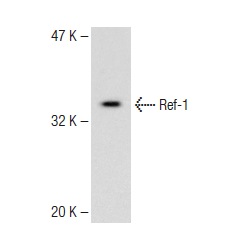
Western blot analysis of Ref-1 expression in KNRK nuclear extract.Application
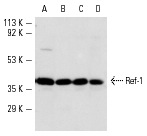
Western blot analysis of Ref-1 expression in Y79 (A), HeLa (B), C32 (C) and NIH/3T3 (D) nuclear extracts.| Product Name | Ref-1 Antibody (C-20) |
|---|---|
| Antibody Type | Primary Antibodies |
| Modification Notes | The role of transcription factors in the regulation of gene expression is well established. Although the activity of these factors can be regulated by phosphorylation, evidence has indicated regulation of DNA binding mediated by changes in reduction-oxidation (redox) status. Mutational analysis has identified a single conserved cysteine residue mapping within the DNA binding domains of Fos and Jun. Chemical oxidation or modification of this cysteine residue inhibits the DNA binding activity of Fos and Jun. A similar mode of regulation has been recently proposed for other nuclear transcription factors. Oxidation is reversible by these compounds or by a cellular redox/DNA repair protein identified originally as Ref-1 (redox factor 1). Ref-1 is identical to a previously characterized DNA repair enzyme designated HAP1, APE or APEX. |
| Clonality | Polyclonal |
|---|---|
| Isotype | IgG |
| Host Species | Rabbit |
| Tested Applications | WBIPIFELISAGSChIP |
| recommended for detection of Ref-1 of mouse, rat and human origin by WB, IP, IF and ELISA also reactive with additional species, including equine, canine, bovine, porcine and avian | |
| Species Reactivity | HumanMouseRat |
| Concentration | 1mg/ml |
| Purification | Affinity purified |
| Alternative Names | epitope mapping at the C-terminus of Ref-1 of human origin |
|---|---|
| Tissue Specificity | epitope mapping at the C-terminus of Ref-1 of human origin |
| Entrez Gene | 328 |
|---|
Application
Western blot analysis of Ref-1 expression in KNRK nuclear extract.
Application
Western blot analysis of Ref-1 expression in Y79 (A), HeLa (B), C32 (C) and NIH/3T3 (D) nuclear extracts.| Application Notes | recommended for detection of Ref-1 of mouse, rat and human origin by WB, IP, IF and ELISA also reactive with additional species, including equine, canine, bovine, porcine and avian |
|---|
| Form | Liquid |
|---|---|
| Storage Instructions | For short-term storage, store at 4° C. For long-term storage, aliquot and store at -20ºC or below. Avoid multiple freeze-thaw cycles. |
| Storage Buffer | phosphate buffered saline , pH 7.4, 150mM NaCl, 0.02% sodium azide and 50% glycerol. |


