Application
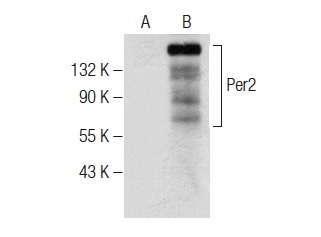
Western blot analysis of Per2 expression in non-transfected: (A) and human Per2 transfected: (B) 293T whole cell lysates.Application
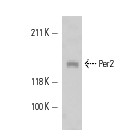
Western blot analysis of Per2 expression in A-10 nuclear extract.| Product Name | Per2 Antibody (H-90) AC |
|---|---|
| Antibody Type | Primary Antibodies |
| Modification Notes | Biological timepieces called circadian clocks are responsible for the regulation of hormonal rhythms, sleep cycles and other behaviors. The superchiasmatic nucleus (SCN), which is located in the brain, was the first mammalian circadian clock to be discovered. A number of transcription factors appearing to be molecular components of the SCN clock have been identified. Mutations within the Clock gene increase the length of the endogenous period and cause a loss of rhythmicity of circadian oscillations. Three mammalian period proteins, designated Per1, Per2 and Per3, exhibit circadian rhythyms in the SCN. During subjective night, Per1 and Per2 RNA levels increase in response to light pulses while Per3 RNA levels show no change in response to light pulses. Tim, for timeless, interacts with Per1 as well as Per2; and Tim and Per1 negatively regulate Clock-BMAL1-induced transcription. |
| Clonality | Polyclonal |
|---|---|
| Isotype | IgG |
| Host Species | Rabbit |
| Tested Applications | WBIPIFELISAGSChIP |
| recommended for detection of Per2 of mouse, rat and human origin by WB, IP, IF and ELISA | |
| Species Reactivity | HumanMouseRat |
| Concentration | 1mg/ml |
| Purification | Affinity purified |
| Alternative Names | epitope corresponding to amino acids 1-90 mapping at the N-terminus of Per2 of human origin |
|---|---|
| Tissue Specificity | epitope corresponding to amino acids 1-90 mapping at the N-terminus of Per2 of human origin |
| Entrez Gene | 8864 |
|---|
Application
Western blot analysis of Per2 expression in non-transfected: (A) and human Per2 transfected: (B) 293T whole cell lysates.
Application
Western blot analysis of Per2 expression in A-10 nuclear extract.| Application Notes | recommended for detection of Per2 of mouse, rat and human origin by WB, IP, IF and ELISA |
|---|
| Form | Liquid |
|---|---|
| Storage Instructions | For short-term storage, store at 4° C. For long-term storage, aliquot and store at -20ºC or below. Avoid multiple freeze-thaw cycles. |
| Storage Buffer | phosphate buffered saline , pH 7.4, 150mM NaCl, 0.02% sodium azide and 50% glycerol. |


