Application
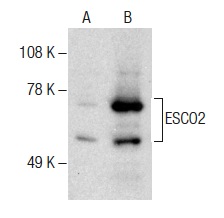
Western blot analysis of ESCO2 expression in non-transfected: (A) and mouse ESCO2 transfected: (B) 293T whole cell lysates.| Product Name | EFO2 Antibody (K-15) |
|---|---|
| Antibody Type | Primary Antibodies |
| Modification Notes | EFO2 (establishment of cohesion 1 homolog 2 (Saccharomyces cerevisiae)) is also known as N-acetyltransferase ESCO2 and is a 601 amino acid protein. EFO2 can be detected throughout fetal tissue and is expressed in adult thymus, placenta and small intestine. EFO2 is thought to cause cohesion of sister cromatids during the S phase of the cell cycle. The C-terminal end of EFO2 may possess acetyltransferase activity, suggesting that EFO2 may also be involved in regulating chromatin structure and, ultimately, gene expression. Defects in the gene encoding EFO2 cause two cohesinopathies, referred to as Roberts syndrome (RBS) and SC phocomelia syndrome, also called SC pseudothalidomide syndrome. RBS is rare, and can have strongly expressed phenotypes, including growth retardation, both prenatal and postnatal, as well as symmetric mesomelia, microcephaly and stillbirth or death soon after birth. SC phocomelia syndrome has a higher rate of adulthood survival than RBS. While both SC phocomelia and RBS are characterized by limb reduction, SC phocomelia is also associated with underdeveloped facial features and contractures of flexion in joints. |
| Clonality | Polyclonal |
|---|---|
| Isotype | IgG |
| Host Species | Rabbit |
| Tested Applications | WBIPIFELISA |
| recommended for detection of EFO2 of human origin and ESCO2 of mouse origin by WB, IP, IF and ELISA non cross-reactive with EFO1 also reactive with additional species, including equine and porcine | |
| Species Reactivity | HumanMouseRat |
| Concentration | 1mg/ml |
| Purification | Affinity purified |
| Alternative Names | epitope mapping within an internal region of EFO2 of human origin |
|---|---|
| Tissue Specificity | epitope mapping within an internal region of EFO2 of human origin |
| Entrez Gene | 157570 |
|---|
Application
Western blot analysis of ESCO2 expression in non-transfected: (A) and mouse ESCO2 transfected: (B) 293T whole cell lysates.| Application Notes | recommended for detection of EFO2 of human origin and ESCO2 of mouse origin by WB, IP, IF and ELISA non cross-reactive with EFO1 also reactive with additional species, including equine and porcine |
|---|
| Form | Liquid |
|---|---|
| Storage Instructions | For short-term storage, store at 4° C. For long-term storage, aliquot and store at -20ºC or below. Avoid multiple freeze-thaw cycles. |
| Storage Buffer | phosphate buffered saline , pH 7.4, 150mM NaCl, 0.02% sodium azide and 50% glycerol. |


