Application
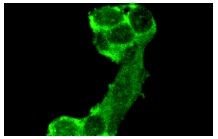
Immunofluorescence staining of methanol-fixed SK-N-SH cells showing cytoskeletal localization.Application
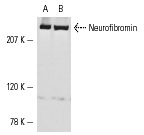
Western blot analysis of Neurofibromin expression in A-431 (A) and HeLa (B) whole cell lysates.| Product Name | Neurofibromin Antibody (D) |
|---|---|
| Antibody Type | Primary Antibodies |
| Antigen Alias | epitope mapping within the C-terminus of Neurofibromin of human origin |
| Modification Notes | Neurofibromatosis type 1 (NF1), or von Reckinghausen neurofibromatosis, is one of the most common autosomal dominant disorders in humans. Early linkage analysis mapped the NF1 gene to chromosome 17. The predicted NF1 transcript encodes the 2,818 amino acid protein Neurofibromin, also designated NF1-GAP-related protein (NF1GRP). By sequence analysis, similarity has been demonstrated within a small region of Neurofibromin and members of the Ras GAP gene family. Functionally, Neurofibromin has been shown by biochemical analysis involving RAS-GAP hydrolysis and functional complementation in yeast to further resemble GAP protein. The Neurofibromin protein is expressed at relatively constant levels in a broad range of cell lines and tissues including brain, lung, liver, kidney, spleen, muscle and colon. Although little is known regarding the function of Neurofibromin, the homology with the catalytic domain of proteins with GTPase activity suggests that Neurofibromin may also interact in vivo with Ras proteins. |
| Clonality | Polyclonal |
|---|---|
| Isotype | IgG |
| Host Species | Rabbit |
| Tested Applications | WBIPIFELISA |
| recommended for detection of Neurofibromin p250 of mouse, rat and human origin by WB, IP, IF and ELISA also reactive with additional species, including equine, canine, porcine and avian: |
|
| Species Reactivity | HumanMouseRat |
| Concentration | 1mg/ml |
| Purification | Affinity purified |
| Alternative Names | epitope mapping within the C-terminus of Neurofibromin of human origin |
|---|---|
| Tissue Specificity | epitope mapping within the C-terminus of Neurofibromin of human origin |
| Entrez Gene | 4763 |
|---|
Application
Immunofluorescence staining of methanol-fixed SK-N-SH cells showing cytoskeletal localization.
Application
Western blot analysis of Neurofibromin expression in A-431 (A) and HeLa (B) whole cell lysates.| Application Notes | recommended for detection of Neurofibromin p250 of mouse, rat and human origin by WB, IP, IF and ELISA also reactive with additional species, including equine, canine, porcine and avian: |
|---|
| Form | Liquid |
|---|---|
| Storage Instructions | For short-term storage, store at 4° C. For long-term storage, aliquot and store at -20ºC or below. Avoid multiple freeze-thaw cycles. |
| Storage Buffer | phosphate buffered saline , pH 7.4, 150mM NaCl, 0.02% sodium azide and 50% glycerol. |


