Application
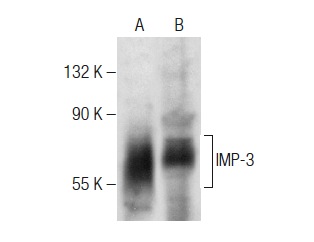
Western blot analysis of IMP-3 expression in Caco-2 whole cell lysate (A) and mouse kidney tissue extract (B).| Product Name | IMP-3 Antibody (H-37) |
|---|---|
| Antibody Type | Primary Antibodies |
| Antigen Alias | epitope corresponding to amino acids 377-413 mapping near the C-terminus of IMP-3 of human origin |
| Modification Notes | IGF-II mRNA-binding proteins (IMPs) bind RNA and influence RNA synthesis and metabolism. IMP-1, also known as coding region determinant-binding protein/insulin-like growth factor II mRNA-binding protein (CRD-BP) and VICKZ1; IMP-2 (IMP2, VICKZ2, p62); and IMP-3 (KOC1, VICKZ3) contain a unique combination of RNA recognition motifs and four hnRNP K homology domains. IMP-1 is abundant in embryonal tissues and is expressed in 81% of colon cancers, 73% of sarcomas and 58.5% of breast cancers. It recognizes c-Myc, IGF-II and t mRNAs, and H19 RNA, and plays a major role in proliferation of K-562 cells by an IGF-II-dependent mechanism. IMP-2 binds the 5' UTR of IGF-II mRNA and influences tumor cell growth, in which IMP-2 is associated with apoptosis induced by tretinoin. IMP-3 knockdown by RNA interference decreases levels of IGF-II protein without affecting IGF-II, c-Myc, or ∫ Actin mRNA and H19 RNA levels. IMP-3 is a marker for carcinomas and high-grade dysplastic lesions of pancreatic ductal epithelium. |
| Clonality | Polyclonal |
|---|---|
| Isotype | IgG |
| Host Species | Rabbit |
| Tested Applications | WBIPIFELISA |
| recommended for detection of IMP-3 of mouse, rat and human origin by WB, IP, IF and ELISA also reactive with additional species, including equine, canine and bovine: |
|
| Species Reactivity | HumanMouseRat |
| Concentration | 1mg/ml |
| Purification | Affinity purified |
| Alternative Names | epitope corresponding to amino acids 377-413 mapping near the C-terminus of IMP-3 of human origin |
|---|---|
| Tissue Specificity | epitope corresponding to amino acids 377-413 mapping near the C-terminus of IMP-3 of human origin |
| Entrez Gene | 10643 |
|---|
Application
Western blot analysis of IMP-3 expression in Caco-2 whole cell lysate (A) and mouse kidney tissue extract (B).| Application Notes | recommended for detection of IMP-3 of mouse, rat and human origin by WB, IP, IF and ELISA also reactive with additional species, including equine, canine and bovine: |
|---|
| Form | Liquid |
|---|---|
| Storage Instructions | For short-term storage, store at 4° C. For long-term storage, aliquot and store at -20ºC or below. Avoid multiple freeze-thaw cycles. |
| Storage Buffer | phosphate buffered saline , pH 7.4, 150mM NaCl, 0.02% sodium azide and 50% glycerol. |


