Application
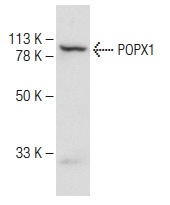
Western blot analysis of POPX1 expression in T98G whole cell lysate.| Product Name | POPX1 Antibody (H-45) |
|---|---|
| Antibody Type | Primary Antibodies |
| Antigen Alias | epitope corresponding to amino acids 298-342 mapping within an internal region of POPX1 of human origin |
| Modification Notes | The phosphorylation and dephosphorylation of proteins on serine and threonine residues is an essential means of regulating a broad range of cellular functions in eukaryotes, including division, homeostasis and apoptosis. A group of proteins that are intimately involved in this process are the serine/threonine protein phosphatases. POPX1 (also known as partner of PIX 1, PPM1E (protein phosphatase 1E) or PP2CH) and POPX2 (also known as partner of PIX 2, PPM1F, CaMKPase (CaM-kinase phosphatase) or FEM-2) belong to the PP2C family of serine/threonine phosphatases. Members of the PP2C family are negative regulators of cell stress response pathways. POPX2 is a ubiquitously expressed protein and POPX1 is predominantly expressed in brain and testis. POPX1 and POPX2 specifically interact with PIX (PAK interacting exchange factor) proteins and negatively regulate the activity of åPAK, a protein kinase that can lead to the breakdown of actin stress fibers and other morphological changes. POPX2 can also interact with and regulate CaMKII activity. Overexpression of POPX2 can result in caspase-dependent apoptosis. |
| Clonality | Polyclonal |
|---|---|
| Isotype | IgG |
| Host Species | Rabbit |
| Tested Applications | WBIPIFELISA |
| recommended for detection of POPX1 of mouse, rat and human origin by WB, IP, IF and ELISA also reactive with additional species, including canine, bovine, porcine and avian: |
|
| Species Reactivity | HumanMouseRat |
| Concentration | 1mg/ml |
| Purification | Affinity purified |
| Alternative Names | epitope corresponding to amino acids 298-342 mapping within an internal region of POPX1 of human origin |
|---|---|
| Tissue Specificity | epitope corresponding to amino acids 298-342 mapping within an internal region of POPX1 of human origin |
| Entrez Gene | 22843 |
|---|
Application
Western blot analysis of POPX1 expression in T98G whole cell lysate.| Application Notes | recommended for detection of POPX1 of mouse, rat and human origin by WB, IP, IF and ELISA also reactive with additional species, including canine, bovine, porcine and avian: |
|---|
| Form | Liquid |
|---|---|
| Storage Instructions | For short-term storage, store at 4° C. For long-term storage, aliquot and store at -20ºC or below. Avoid multiple freeze-thaw cycles. |
| Storage Buffer | phosphate buffered saline , pH 7.4, 150mM NaCl, 0.02% sodium azide and 50% glycerol. |


