Application
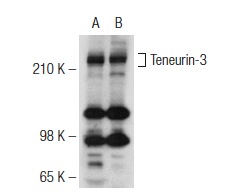
Western blot analysis of Teneurin-3 expression in K-562 (A) and IMR-32 (B) whole cell lysates.| Product Name | Teneurin-3 Antibody (V-12) |
|---|---|
| Antibody Type | Primary Antibodies |
| Modification Notes | Teneurin-3, also known as Ten-3, TNM3 or ODZ3, is a 2,699 amino acid single-pass type II membrane protein that contains 25 YD repeats, 8 EGF-like domains, 5 NHL repeats and one teneurin N-terminal domain. Localized to the membrane and expressed in brain, testis and ovary, Teneurin-3 exists as a disulfide-liked homodimer that is thought to function as a cellular signal transducer. Additionally, Teneurin-3 may participate in eye-specific patterning in the visual pathway and is required for aligned binocular vision. The gene encoding Teneurin-3 maps to chromosome 4. Representing approximately 6% of the human genome, chromosome 4 contains nearly 900 genes, one of which is the Huntingtin gene, which is found to encode an expanded glutamine tract in cases of Huntington's disease. FGFR-3 is also encoded on chromosome 4 and has been associated with thanatophoric dwarfism, achondroplasia, Muenke syndrome and bladder cancer. Chromosome 4 is also tied to Ellis-van Creveld syndrome, methylmalonic acidemia and polycystic kidney disease. |
| Clonality | Polyclonal |
|---|---|
| Isotype | IgG |
| Host Species | Rabbit |
| Tested Applications | WBIPIFELISA |
| recommended for detection of Teneurin-3 of mouse, rat and human origin by WB, IP, IF and ELISA non cross-reactive with Teneurin-1 or Teneurin-2 | |
| Species Reactivity | HumanMouseRat |
| Concentration | 1mg/ml |
| Purification | Affinity purified |
| Alternative Names | epitope mapping within an extracellular domain of Teneurin-3 of human origin |
|---|---|
| Tissue Specificity | epitope mapping within an extracellular domain of Teneurin-3 of human origin |
| Entrez Gene | 55714 |
|---|
Application
Western blot analysis of Teneurin-3 expression in K-562 (A) and IMR-32 (B) whole cell lysates.| Application Notes | recommended for detection of Teneurin-3 of mouse, rat and human origin by WB, IP, IF and ELISA non cross-reactive with Teneurin-1 or Teneurin-2 |
|---|
| Form | Liquid |
|---|---|
| Storage Instructions | For short-term storage, store at 4° C. For long-term storage, aliquot and store at -20ºC or below. Avoid multiple freeze-thaw cycles. |
| Storage Buffer | phosphate buffered saline , pH 7.4, 150mM NaCl, 0.02% sodium azide and 50% glycerol. |


