Application
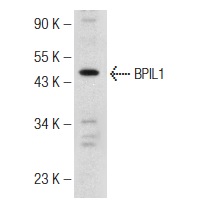
Western blot analysis of BPIL1 expression in U-698-M whole cell lysate.| Product Name | BPIL1 Antibody (S-19) |
|---|---|
| Antibody Type | Primary Antibodies |
| Modification Notes | Members of the bactericidal/permeability-increasing protein family have antimicrobial properties and bind lipophilic substances, therefore targeting gram-negative bacteria. The bactericidal permeability increasing protein (BPI) is an antibacterial and endotoxin-neutralizing molecule that is abundant in the granules of polymorphonuclear leukocytes (neutrophil granules). Sharing structural and sequence homologies with BPI, BPIL1 (bactericidal/permeability-increasing protein-like 1) is a 458 amino acid secreted protein that contains the family’s common conserved feature of two cysteine residues that are critical for protein function. While BPIL1 is primarily expressed at low levels in tonsil tissue, it has been found to be upregulated in hypertrophic tonsils, suggesting that it may play a role in the pathogenesis of inflamed disease tissue. |
| Clonality | Polyclonal |
|---|---|
| Isotype | IgG |
| Host Species | Rabbit |
| Tested Applications | WBIPIFELISA |
| recommended for detection of BPIL1 of human origin by WB, IP, IF and ELISA non cross-reactive with BPIL2 and BPIL3 | |
| Species Reactivity | HumanMouseRat |
| Concentration | 1mg/ml |
| Purification | Affinity purified |
| Alternative Names | epitope mapping within an internal region of BPIL1 of human origin |
|---|---|
| Tissue Specificity | epitope mapping within an internal region of BPIL1 of human origin |
| Entrez Gene | 80341 |
|---|
Application
Western blot analysis of BPIL1 expression in U-698-M whole cell lysate.| Application Notes | recommended for detection of BPIL1 of human origin by WB, IP, IF and ELISA non cross-reactive with BPIL2 and BPIL3 |
|---|
| Form | Liquid |
|---|---|
| Storage Instructions | For short-term storage, store at 4° C. For long-term storage, aliquot and store at -20ºC or below. Avoid multiple freeze-thaw cycles. |
| Storage Buffer | phosphate buffered saline , pH 7.4, 150mM NaCl, 0.02% sodium azide and 50% glycerol. |


