Application
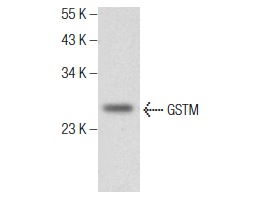
Western blot analysis of GSTM expression in A-673 whole cell lysate.| Product Name | GSTM Antibody (FL-218) |
|---|---|
| Antibody Type | Primary Antibodies |
| Modification Notes | Members of the glutathione S-transferase (GST) family of proteins function in the detoxification of xenobiotics to protect cells against toxicant-induced damage. There are eight families of GST proteins, namely alpha, zeta, theta, kappa, mu, pi, sigma and omega, each of which are composed of proteins that have a variety of functions throughout the cell. The GSTM proteins (GSTM1-GSTM5 in human and GSTM1-GSTM7 in mouse) are members of the mu class of enzymes that conjugate with glutathione and function in the detoxification of carcinogens, environmental toxins and products of oxidative stress. GSTM3 is a 225 amino acid protein that is expressed in the testis and brain. Localized to the cytoplasm, GSTM3 exists as a homodimer. |
| Clonality | Polyclonal |
|---|---|
| Isotype | IgG |
| Host Species | Rabbit |
| Tested Applications | WBIPIFELISA |
| recommended for detection of GSTM1, GSTM2, GSTM3, GSTM4 and GSTM5 of mouse, rat and human origin and Gstm6 and Gstm7 of mouse and rat origin by WB, IP, IF and ELISA | |
| Species Reactivity | HumanMouseRat |
| Concentration | 1mg/ml |
| Purification | Affinity purified |
| Alternative Names | epitope corresponding to amino acids 1-218 representing full length GSTM2 of human origin |
|---|---|
| Tissue Specificity | epitope corresponding to amino acids 1-218 representing full length GSTM2 of human origin |
| Entrez Gene | 2944 |
|---|
Application
Western blot analysis of GSTM expression in A-673 whole cell lysate.| Application Notes | recommended for detection of GSTM1, GSTM2, GSTM3, GSTM4 and GSTM5 of mouse, rat and human origin and Gstm6 and Gstm7 of mouse and rat origin by WB, IP, IF and ELISA |
|---|
| Form | Liquid |
|---|---|
| Storage Instructions | For short-term storage, store at 4° C. For long-term storage, aliquot and store at -20ºC or below. Avoid multiple freeze-thaw cycles. |
| Storage Buffer | phosphate buffered saline , pH 7.4, 150mM NaCl, 0.02% sodium azide and 50% glycerol. |


