Application
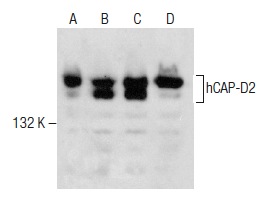
Western blot analysis of hCAP-D2 expression in Jurkat (A), K-562 (B), Ramos (C) and NIH/3T3 (D) whole cell lysates.| Product Name | hCAP-D2 Antibody (H-300) |
|---|---|
| Antibody Type | Primary Antibodies |
| Modification Notes | The condensin complex plays a role in the resolution and segregation of sister chromatids during mitosis and some aspects of mitotic chromosome assembly. Cdc2 phosphorylation of the complex leads to its activation and its association with chromosome arms and condensation. Condensin complexes are heteropentamers comprised of two SMC (structural maintenance of chromosomes) subunits and three non-SMC subunits. The SMC family includes SMC1 (also known as SMC1å and SCMB), which associates with SMC3 (also known as hCAP and Bamacan); SMC2 (also known as hCAP-E), which associates with SMC4 (also known as hCAP-C); and SMC5, which associates with SMC6. Non-SMC subunits help regulate the complex and include hCAP-D2, hCAP-H and hCAP-G. The C-terminus of hCAP-D2 interacts with Histones H1 and H3 through their histone tails. A loss of hCAP-D2 can lead to the disorganization of chromatid axes, misalignment of sister chromatids during metaphase and delayed entry into anaphase. |
| Clonality | Polyclonal |
|---|---|
| Isotype | IgG |
| Host Species | Rabbit |
| Tested Applications | WBIPIFELISA |
| recommended for detection of hCAP-D2 (Chromosome-associated protein D2) of mouse, rat and human origin by WB, IP, IF and ELISA also reactive with additional species, including canine and bovine | |
| Species Reactivity | HumanMouseRat |
| Concentration | 1mg/ml |
| Purification | Affinity purified |
| Alternative Names | epitope corresponding to amino acids 1102-1401 mapping at the C-terminus of hCAP-D2 of human origin |
|---|---|
| Tissue Specificity | epitope corresponding to amino acids 1102-1401 mapping at the C-terminus of hCAP-D2 of human origin |
Application
Western blot analysis of hCAP-D2 expression in Jurkat (A), K-562 (B), Ramos (C) and NIH/3T3 (D) whole cell lysates.| Application Notes | recommended for detection of hCAP-D2 (Chromosome-associated protein D2) of mouse, rat and human origin by WB, IP, IF and ELISA also reactive with additional species, including canine and bovine |
|---|
| Form | Liquid |
|---|---|
| Storage Instructions | For short-term storage, store at 4° C. For long-term storage, aliquot and store at -20ºC or below. Avoid multiple freeze-thaw cycles. |
| Storage Buffer | phosphate buffered saline , pH 7.4, 150mM NaCl, 0.02% sodium azide and 50% glycerol. |


