Application
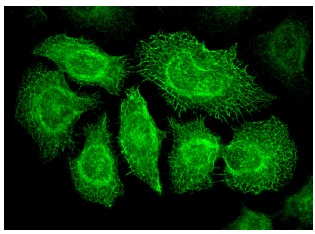
Immunofluorescence staining of methanol-fixed HeLa cells showing membrane localization.Application
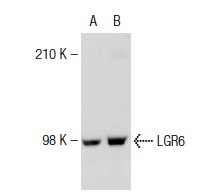
Western blot analysis of LGR6 expression in HeLa (A) and HISM (B) whole cell lysates.| Product Name | LGR6 Antibody (H-90) |
|---|---|
| Antibody Type | Primary Antibodies |
| Modification Notes | G protein-coupled receptors (GPCRs), also designated seven transmembrane (7TM) receptors and heptahelical receptors, are a protein family which interact with G proteins (heterotrimeric GTPases) to synthesize intracellular second messengers such as diacylglycerol, cyclic AMP, inositol phosphates and calcium ions. Their diverse biological functions range from vision and olfaction to neuronal and endocrine signaling and are involved in many pathological conditions. The GPCR family represents the largest class of targets for modern drugs. Leucine-rich repeat-containing G protein-coupled receptor 6 (LGR6) is an orphan-A GPCR with an N-terminal ectodomain comprising variable leucine-rich repeats, a 7TM region and a unique C-terminal intracellular tail. The sequence of LGR6 is similar to TSHR, FSHR and LHR. LGR6 is predominantly expres-sed in the adrenal gland, ovary and uterus. |
| Clonality | Polyclonal |
|---|---|
| Isotype | IgG |
| Host Species | Rabbit |
| Tested Applications | WBIPIFELISA |
| recommended for detection of LGR6 isoforms 1, 2 and 3 of mouse, rat and human origin by WB, IP, IF and ELISA also reactive with additional species, including equine, canine and porcine | |
| Species Reactivity | HumanMouseRat |
| Concentration | 1mg/ml |
| Purification | Affinity purified |
| Alternative Names | epitope corresponding to amino acids 326-415 mapping within an N-terminal extracellular domain of LGR6 of human origin |
|---|---|
| Tissue Specificity | epitope corresponding to amino acids 326-415 mapping within an N-terminal extracellular domain of LGR6 of human origin |
| Entrez Gene | 59352 |
|---|
Application
Immunofluorescence staining of methanol-fixed HeLa cells showing membrane localization.
Application
Western blot analysis of LGR6 expression in HeLa (A) and HISM (B) whole cell lysates.| Application Notes | recommended for detection of LGR6 isoforms 1, 2 and 3 of mouse, rat and human origin by WB, IP, IF and ELISA also reactive with additional species, including equine, canine and porcine |
|---|
| Form | Liquid |
|---|---|
| Storage Instructions | For short-term storage, store at 4° C. For long-term storage, aliquot and store at -20ºC or below. Avoid multiple freeze-thaw cycles. |
| Storage Buffer | phosphate buffered saline , pH 7.4, 150mM NaCl, 0.02% sodium azide and 50% glycerol. |


