Application
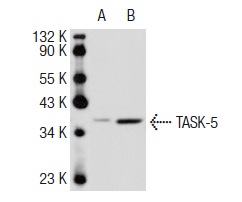
Western blot analysis of TASK-5 expression in MIA PaCa-2 (A) and JEG-3 (B) whole cell lysates.| Product Name | TASK-5 Antibody (K-14) |
|---|---|
| Antibody Type | Primary Antibodies |
| Modification Notes | Potassium (K+) channels are very widely distributed ion channels that function in regulating charged gradients across cell membranes which are important for resting potential generation, hormonal release and water retention. Potassium channels contain four protein subunits surrounding a central ion conducting pore. The protein subunits can be homotetrameric, producing a symmetric C4 complex, or heterotetrameric, producing a pseudo-symmetric complex. TASK-5 (potassium channel subfamily K member 15), also known as KCNK15, is a potential potassium channel subunit that is thought to form a heterodimer to complete the functional potassium channel. TASK-5 is a membrane bound 330 amino acid polypeptide found at abundant levels in pancreas, heart, placenta, lung, liver, kidney, ovary, testis, skeletal muscle and adrenal gland. TASK-5A, TASK-5B, and TASK-5C are the three known variants of TASK-5 at the protein level. |
| Clonality | Polyclonal |
|---|---|
| Isotype | IgG |
| Host Species | Rabbit |
| Tested Applications | WBIPIFELISA |
| recommended for detection of TASK-5 of human origin by WB, IP, IF and ELISA non cross-reactive with TASK-1, TASK-2, and TASK-3. | |
| Species Reactivity | HumanMouseRat |
| Concentration | 1mg/ml |
| Purification | Affinity purified |
| Alternative Names | epitope mapping within a cytoplasmic domain of TASK-5 of human origin |
|---|---|
| Tissue Specificity | epitope mapping within a cytoplasmic domain of TASK-5 of human origin |
| Entrez Gene | 60598 |
|---|
Application
Western blot analysis of TASK-5 expression in MIA PaCa-2 (A) and JEG-3 (B) whole cell lysates.| Application Notes | recommended for detection of TASK-5 of human origin by WB, IP, IF and ELISA non cross-reactive with TASK-1, TASK-2, and TASK-3. |
|---|
| Form | Liquid |
|---|---|
| Storage Instructions | For short-term storage, store at 4° C. For long-term storage, aliquot and store at -20ºC or below. Avoid multiple freeze-thaw cycles. |
| Storage Buffer | phosphate buffered saline , pH 7.4, 150mM NaCl, 0.02% sodium azide and 50% glycerol. |


