Application
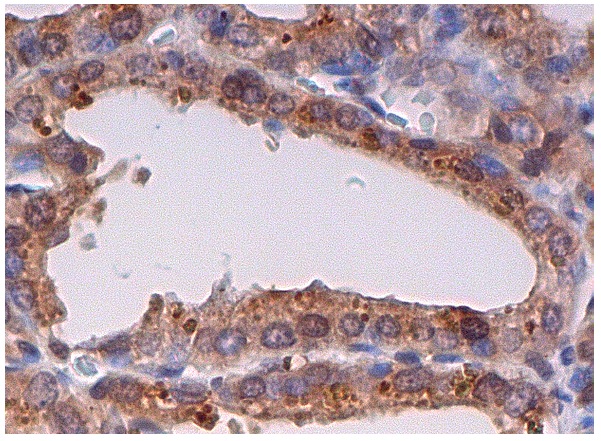
Immunoperoxidase staining of formalin fixed, paraffin-embedded human seminal vesicle tissue showing nuclear and cytoplasmic staining of glandular cells.| Product Name | EHZF Antibody (S-15) |
|---|---|
| Antibody Type | Primary Antibodies |
| Modification Notes | EHZF (early hematopoietic zinc finger protein), also known as zinc finger protein 521 or LYST-interacting protein 3, is a 1,311 amino acid transcription factor that can act as a repressor or an activator of gene transcription. Predominantly expressed in progenitor hematopoietic cells and organs with reduced expression during differentiation, this nuclear protein contains 30 C2H2 Kruppel-type zinc fingers that are distributed in clusters throughout its sequence. As a member of the BMP (bone morphogenetic protein) signaling pathway, EHZF interacts with SMAD proteins to activate transcription of BMP target genes. Through interaction with EBF1 (early B-cell factor 1), EHZF represses transcription by preventing EBF-DNA binding. With high expression observed in most acute myelogenous leukemias, medulloblastomas and other brain tumors, it is suspected the EHZF may play a role in oncogenesis. |
| Clonality | Polyclonal |
|---|---|
| Isotype | IgG |
| Host Species | Rabbit |
| Tested Applications | WBIFIHCELISA |
| recommended for detection of EHZF of mouse, rat and human origin by WB, IF, IHC(P) and ELISA also reactive with additional species, including equine, canine, bovine, porcine and avian | |
| Species Reactivity | HumanMouseRat |
| Concentration | 1mg/ml |
| Purification | Affinity purified |
| Alternative Names | epitope mapping within an internal region of EHZF of human origin |
|---|---|
| Tissue Specificity | epitope mapping within an internal region of EHZF of human origin |
| Entrez Gene | 25925 |
|---|
Application
Immunoperoxidase staining of formalin fixed, paraffin-embedded human seminal vesicle tissue showing nuclear and cytoplasmic staining of glandular cells.| Application Notes | recommended for detection of EHZF of mouse, rat and human origin by WB, IF, IHC(P) and ELISA also reactive with additional species, including equine, canine, bovine, porcine and avian |
|---|
| Form | Liquid |
|---|---|
| Storage Instructions | For short-term storage, store at 4° C. For long-term storage, aliquot and store at -20ºC or below. Avoid multiple freeze-thaw cycles. |
| Storage Buffer | phosphate buffered saline , pH 7.4, 150mM NaCl, 0.02% sodium azide and 50% glycerol. |


