Application
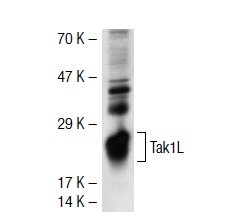
Western blot analysis of Tak1L expression in mouse kidney tissue extract.| Product Name | Tak1L Antibody (D-16) |
|---|---|
| Antibody Type | Primary Antibodies |
| Antigen Alias | epitope mapping within an internal region of Tak1L of human origin |
| Modification Notes | Several serine/threonine protein kinases have been implicated as intermediates in signal transduction pathways. These include ERK/MAP kinases, ribosomal S6 kinase (Rsk) and Raf-1. Raf-1 is a protein with intrinsic kinase activity towards serine/threonine residues and is widely expressed in many tissue types and cell lines. Raf-1 activation is dependent on the small molecular weight GTPase Ras. Two proteins putatively involved in this process are Ksr-1 and Tak1. Ksr-1 (kinase suppressor of Ras) is a novel Raf-related protein kinase whose function is required for Ras signal transduction. Whether Ksr-1 lies directly downstream of Ras or acts in a parallel pathway is not yet known. Tak1 (TGFß-activated kinase) has been shown to participate in the activation of the MAP kinase family in response to TGFß stimulation. Tak1L (Tak1-like protein), also known as C21orf7, is a 242 amino acid protein that shares homology with the C-terminal tail of Tak1. Tak1L is expressed predominantly in peripheral blood leukocytes, with strong expression found in the adenocarcinomic cell lines GI-112 and PC-3 and the carcinomic cell line GI-101. |
| Clonality | Polyclonal |
|---|---|
| Isotype | IgG |
| Host Species | Rabbit |
| Tested Applications | WBIPIFELISA |
| recommended for detection of Tak1L of mouse, rat and human origin by WB, IP, IF and ELISA also reactive with additional species, including equine, canine and bovine: |
|
| Species Reactivity | HumanMouseRat |
| Concentration | 1mg/ml |
| Purification | Affinity purified |
| Alternative Names | epitope mapping within an internal region of Tak1L of human origin |
|---|---|
| Tissue Specificity | epitope mapping within an internal region of Tak1L of human origin |
| Entrez Gene | 56911 |
|---|
Application
Western blot analysis of Tak1L expression in mouse kidney tissue extract.| Application Notes | recommended for detection of Tak1L of mouse, rat and human origin by WB, IP, IF and ELISA also reactive with additional species, including equine, canine and bovine: |
|---|
| Form | Liquid |
|---|---|
| Storage Instructions | For short-term storage, store at 4° C. For long-term storage, aliquot and store at -20ºC or below. Avoid multiple freeze-thaw cycles. |
| Storage Buffer | phosphate buffered saline , pH 7.4, 150mM NaCl, 0.02% sodium azide and 50% glycerol. |


