Application
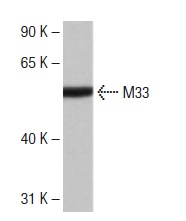
Western blot analysis of M33 expression in human heart tissue extract.| Product Name | M33 Antibody (Y-23) |
|---|---|
| Antibody Type | Primary Antibodies |
| Modification Notes | Polycomb group (PcG) proteins form multiprotein complexes and play a role in gene silencing and Hox gene regulation by altering chromatin structure during transcription. The PcG protein M33, also known as CBX2 or MOD2, controls the accessibility of retinoic acid response elements in the vicinity of Hox genes regulatory regions by direct and/or indirect mechanisms. MPc2 and MPc3 are PcG proteins that show structural similarity to M33 and, like M33, bind the PcG protein RING1 through a conserved c-box motif located in the C-terminus of RING1. Both M33 and BMI-1 have an influence on positions effect variegation (PEV), which is the suppression of protein expression in a proportion of cells. M33 deficiency may cause sex reversal by interfering with steps upstream of the Y-chromosome-specific SRY gene. M33 may also be involved in two different pathologies: the campomelic syndrome, an inherited disorder, and neoplastic disorders linked to allele loss in this region. |
| Clonality | Polyclonal |
|---|---|
| Isotype | IgG |
| Host Species | Rabbit |
| Tested Applications | WBIPELISA |
| Species Reactivity | HumanMouseRat |
| Concentration | 1mg/ml |
| Purification | Affinity purified |
| Alternative Names | recommended for detection of M33 of mouse and human origin by WB IP and ELISA |
|---|---|
| Tissue Specificity | recommended for detection of M33 of mouse and human origin by WB, IP and ELISA |
| Entrez Gene | 84733 |
|---|
Application
Western blot analysis of M33 expression in human heart tissue extract.| Form | Liquid |
|---|---|
| Storage Instructions | For short-term storage, store at 4° C. For long-term storage, aliquot and store at -20ºC or below. Avoid multiple freeze-thaw cycles. |
| Storage Buffer | phosphate buffered saline , pH 7.4, 150mM NaCl, 0.02% sodium azide and 50% glycerol. |


