Application
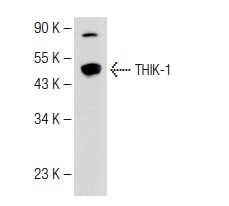
Western blot analysis of THIK-1 expression in IMR-32 whole cell lysate.| Product Name | THIK-1 Antibody (Z-21) |
|---|---|
| Antibody Type | Primary Antibodies |
| Antigen Alias | recommended for detection of THIK-1 of human origin by WB, IP, IF, IHC(P) and ELISA |
| Modification Notes | Potassium channels play an important role in cell excitability and plasticity. The pore loop domain, a highly conserved region common to all potassium channels, is involved in determining potassium ion selectivity. The family of potassium channels possessing two-pore loop domains consists of both inward and outwardly rectifying channels and includes THIK-1, THIK-2, TRESK, TALK-1 and TALK-2. Members of this family are all characterized by four transmembrane domains and may function to help influence the resting membrane potential of cells. TWIK-related halothane-inhibited K+ 1 (THIK-1) is a 405 amino acid protein that localizes to the outer membrane and is abundantly expressed in the central nervous system. THIK-1 has a strong sensitivity to oxygen and may play a physiological and/or pathological role during brain ischemia. |
| Clonality | Polyclonal |
|---|---|
| Isotype | IgG |
| Host Species | Rabbit |
| Tested Applications | WBIPIFIHCELISA |
| WB:1:500~1:2000 IP:1:100~1:500 IF:1:200~1:500 IHC:1:50~1:200 Notes:Optimal dilutions/concentrations should be determined by the researcher. |
|
| Species Reactivity | HumanMouseRat |
| Concentration | 1mg/ml |
| Purification | Affinity purified |
| Alternative Names | recommended for detection of THIK-1 of human origin by WB IP IF IHC(P) and ELISA |
|---|---|
| Tissue Specificity | recommended for detection of THIK-1 of human origin by WB, IP, IF, IHC(P) and ELISA |
| Entrez Gene | 56659 |
|---|
Application
Western blot analysis of THIK-1 expression in IMR-32 whole cell lysate.| Application Notes | WB:1:500~1:2000 IP:1:100~1:500 IF:1:200~1:500 IHC:1:50~1:200 Notes:Optimal dilutions/concentrations should be determined by the researcher. |
|---|
| Form | Liquid |
|---|---|
| Storage Instructions | For short-term storage, store at 4° C. For long-term storage, aliquot and store at -20ºC or below. Avoid multiple freeze-thaw cycles. |
| Storage Buffer | phosphate buffered saline , pH 7.4, 150mM NaCl, 0.02% sodium azide and 50% glycerol. |


