Application
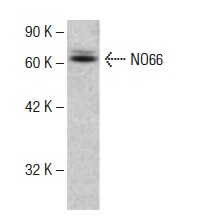
Western blot analysis of NO66 expression in Hep G2 whole cell lysate.| Product Name | NO66 Antibody (P-25) |
|---|---|
| Antibody Type | Primary Antibodies |
| Antigen Alias | recommended for detection of NO66 of human origin by WB, IP and ELISA |
| Modification Notes | The nucleolus is an essential component of the nucleus which functions in the synthesis, processing and assembly of ribosomal RNAs with ribosomal proteins. NO66 (nucleolar protein 66 kDa), also known as C14orf169 (chromosome 14 open reading frame 169) , is a 641 amino acid protein that localizes to nucleoplasmic foci and nucleoli, with specific localization to a granular part of the nucleolus. Expressed throughout the body, NO66 is thought to play a role in the remodeling of certain heterochromatic regions, as well as in the synthesis of the large ribosomal subunit, suggesting involvement in replication-related events. NO66 contains one JmjC domain, two putative nuclear localization signals and several potential phosphorylation sites. Immunohistochemical analysis indicates that NO66 localizes to different subnuclear compartments in different cell lines. Homologs of NO66 have been detected in cell lines from a variety of species. NO66 may be a novel therapeutic target oncogene for lung cancer. |
| Clonality | Polyclonal |
|---|---|
| Isotype | IgG |
| Host Species | Rabbit |
| Tested Applications | WBIPELISA |
| WB:1:500~1:2000 IP:1:100~1:500 Notes:Optimal dilutions/concentrations should be determined by the researcher. |
|
| Species Reactivity | HumanMouseRat |
| Concentration | 1mg/ml |
| Purification | Affinity purified |
| Alternative Names | recommended for detection of NO66 of human origin by WB IP and ELISA |
|---|---|
| Tissue Specificity | recommended for detection of NO66 of human origin by WB, IP and ELISA |
| Entrez Gene | 79697 |
|---|
Application
Western blot analysis of NO66 expression in Hep G2 whole cell lysate.| Application Notes | WB:1:500~1:2000 IP:1:100~1:500 Notes:Optimal dilutions/concentrations should be determined by the researcher. |
|---|
| Form | Liquid |
|---|---|
| Storage Instructions | For short-term storage, store at 4° C. For long-term storage, aliquot and store at -20ºC or below. Avoid multiple freeze-thaw cycles. |
| Storage Buffer | phosphate buffered saline , pH 7.4, 150mM NaCl, 0.02% sodium azide and 50% glycerol. |


