Application
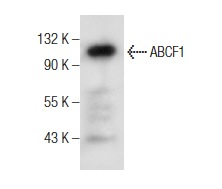
Western blot analysis of ABCF1 expression in K-562 whole cell lysate.Application
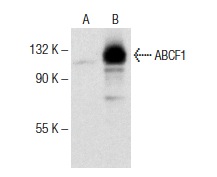
Western blot analysis of ABCF1 expression in non-transfected: (A) and human ABCF1 transfected: (B) 293T whole cell lysates.| Product Name | ABCF1 Antibody (H-135) |
|---|---|
| Antibody Type | Primary Antibodies |
| Antigen Alias | epitope corresponding to amino acids 524-658 mapping within an internal region of ABCF1 of human origin |
| Modification Notes | ABCF1 (ATP-binding cassette sub-family F member 1, TNF-alpha-stimulated ABC protein) is a 845 amino acid protein encoded by the human gene ABCF1. ABCF1 belongs to the ABC transporter family (EF3 subfamily) and contains two ABC transporter domains. ABC proteins transport various molecules across extra- and intra-cellular membranes. ABC genes are divided into seven distinct subfamilies (ABC1, MDR/TAP, MRP, ALD, OABP, GCN20, White). Unlike other members of the superfamily, this protein lacks the transmembrane domains which are characteristic of most ABC transporters. ABCF1 is believed to have a role in mRNA translation due to its interaction with eukaryotic initiation factor 2 (eIF2). It is also associated with ribosomes. ABCF1 is ubiquitously expressed and can be induced with TNF. Upon DNA damage, ABCF1 is phosphorylated by either ATM or ATR. |
| Clonality | Polyclonal |
|---|---|
| Isotype | IgG |
| Host Species | Rabbit |
| Tested Applications | WBIPIFELISA |
| recommended for detection of ABCF1 of mouse, rat and human origin by WB, IP, IF and ELISA also reactive with additional species, including canine, bovine and porcine: |
|
| Species Reactivity | HumanMouseRat |
| Concentration | 1mg/ml |
| Purification | Affinity purified |
| Alternative Names | epitope corresponding to amino acids 524-658 mapping within an internal region of ABCF1 of human origin |
|---|---|
| Tissue Specificity | epitope corresponding to amino acids 524-658 mapping within an internal region of ABCF1 of human origin |
| Entrez Gene | 23 |
|---|
Application
Western blot analysis of ABCF1 expression in K-562 whole cell lysate.
Application
Western blot analysis of ABCF1 expression in non-transfected: (A) and human ABCF1 transfected: (B) 293T whole cell lysates.| Application Notes | recommended for detection of ABCF1 of mouse, rat and human origin by WB, IP, IF and ELISA also reactive with additional species, including canine, bovine and porcine: |
|---|
| Form | Liquid |
|---|---|
| Storage Instructions | For short-term storage, store at 4° C. For long-term storage, aliquot and store at -20ºC or below. Avoid multiple freeze-thaw cycles. |
| Storage Buffer | phosphate buffered saline , pH 7.4, 150mM NaCl, 0.02% sodium azide and 50% glycerol. |


