Application
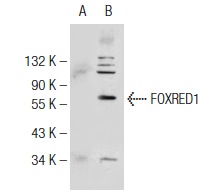
Western blot analysis of FOXRED1 expression in non-transfected: (A) and human FOXRED1 transfected: (B) 293T whole cell lysates.| Product Name | FOXRED1 Antibody (D-15) |
|---|---|
| Antibody Type | Primary Antibodies |
| Antigen Alias | epitope mapping within an internal region of FOXRED1 of human origin |
| Modification Notes | FOXRED1 (FAD-dependent oxidoreductase domain-containing protein 1), also known as FP634, is a 486 amino acid single-pass membrane protein. Utilizing FAD as a cofactor, FOXRED1 may act as a chaperone protein essential for the function of mitochondrial complex I. Mutations to FOXRED1 may result in mitochondrial complex I deficiency (MT-C1D), which results in a wide range of clinical maladies from lethal neonatal disease to adult onset neurodegenerative disorders. Common phenotypes of MT-C1D include cardiomyopathy, liver disease, Leigh syndrome, Leber hereditary optic neuropathy, and some forms of Parkinson disease. FOXRED1 exists as three alternatively spliced isoforms and is encoded by a gene mapping to human chromosome 11q24.2. With approximately 135 million base pairs and 1,400 genes, chromosome 11 makes up around 4% of human genomic DNA and is considered a gene and disease association dense chromosome. |
| Clonality | Polyclonal |
|---|---|
| Isotype | IgG |
| Host Species | Rabbit |
| Tested Applications | WBIPIFELISA |
| recommended for detection of FOXRED1 of mouse, rat and human origin by WB, IP, IF and ELISA non cross-reactive with FOXRED2 also reactive with additional species, including equine and bovine: |
|
| Species Reactivity | HumanMouseRat |
| Concentration | 1mg/ml |
| Purification | Affinity purified |
| Alternative Names | epitope mapping within an internal region of FOXRED1 of human origin |
|---|---|
| Tissue Specificity | epitope mapping within an internal region of FOXRED1 of human origin |
| Entrez Gene | 55572 |
|---|
Application
Western blot analysis of FOXRED1 expression in non-transfected: (A) and human FOXRED1 transfected: (B) 293T whole cell lysates.| Application Notes | recommended for detection of FOXRED1 of mouse, rat and human origin by WB, IP, IF and ELISA non cross-reactive with FOXRED2 also reactive with additional species, including equine and bovine: |
|---|
| Form | Liquid |
|---|---|
| Storage Instructions | For short-term storage, store at 4° C. For long-term storage, aliquot and store at -20ºC or below. Avoid multiple freeze-thaw cycles. |
| Storage Buffer | phosphate buffered saline , pH 7.4, 150mM NaCl, 0.02% sodium azide and 50% glycerol. |


