Application
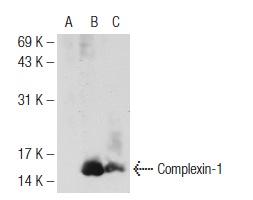
Western blot analysis of Complexin-1 expression in non-transfected: (A) and humaan Complexin-1 transfected: (B) 293T whole cell lysates and mouse brain tissue extract (C).| Product Name | Complexin-1/2 Antibody (FL-134) |
|---|---|
| Antibody Type | Primary Antibodies |
| Antigen Alias | epitope corresponding to amino acids 1-134 representing full length Complexin-1 of human origin |
| Modification Notes | Complexin 1 and Complexin 2, also designated Synaphin 1 and Synaphin 2, contain an a-helical middle domain of approximately 58 amino acids. Complexin 1 and Complexin 2 are expressed in presynaptic terminals of inhibitory and excitatory hippocampal neurons, respectively, and in cytoplasmic pools during early stages of development. Complexins promote SNARE (soluble N-ethylmaleimide-sensitive factor attachment protein receptors) precomplex formation by binding to synaxin with its a-helical domain. Complexins are important regulators of transmitter release at a late step in calcium dependent neurotransmitter release or immediately after the calcium-triggering step of fast synchronous transmitter release and preceding vesicle fusion. Neurons lacking complexins show reduced transmitter release efficiency due to decreased calcium sensitivity of the synaptic secretion process. Complexin 2 may play a role in LTP (long term potentiation) following tetanic stimulation. A progressive loss of Complexin 2 occurs in the brains of mice carrying the Huntington disease mutation, an autosomal dominant neurodegenerative disorder. Changes in the neurotransmitter release might contribute to the motor, emotional and cognitive dysfunctions seen in these mice. |
| Clonality | Polyclonal |
|---|---|
| Isotype | IgG |
| Host Species | Rabbit |
| Tested Applications | WBIPIFELISA |
| recommended for detection of Complexin-1 and Complexin-2 of mouse, rat and human origin by WB, IP, IF and ELISA also reactive with additional species, including canine, bovine, porcine and avian: |
|
| Species Reactivity | HumanMouseRat |
| Concentration | 1mg/ml |
| Purification | Affinity purified |
| Alternative Names | epitope corresponding to amino acids 1-134 representing full length Complexin-1 of human origin |
|---|---|
| Tissue Specificity | epitope corresponding to amino acids 1-134 representing full length Complexin-1 of human origin |
| Entrez Gene | 10814 |
|---|
Application
Western blot analysis of Complexin-1 expression in non-transfected: (A) and humaan Complexin-1 transfected: (B) 293T whole cell lysates and mouse brain tissue extract (C).| Application Notes | recommended for detection of Complexin-1 and Complexin-2 of mouse, rat and human origin by WB, IP, IF and ELISA also reactive with additional species, including canine, bovine, porcine and avian: |
|---|
| Form | Liquid |
|---|---|
| Storage Instructions | For short-term storage, store at 4° C. For long-term storage, aliquot and store at -20ºC or below. Avoid multiple freeze-thaw cycles. |
| Storage Buffer | phosphate buffered saline , pH 7.4, 150mM NaCl, 0.02% sodium azide and 50% glycerol. |


