Application
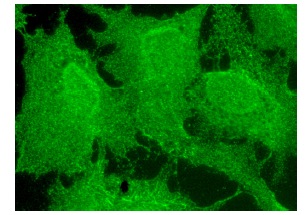
Immunofluorescence staining of formalin-fixed Hep G2 cells showing nuclear and cytoplasmic localization.| Product Name | ANKRD60 Antibody (G-19) |
|---|---|
| Antibody Type | Primary Antibodies |
| Antigen Alias | epitope mapping within an internal region of ANKRD60 of human origin |
| Modification Notes | Ankyrins are membrane adaptor molecules that play important roles in coupling integral membrane proteins to the spectrin-based cytoskeleton network. Mutations of ankyrin genes lead to severe genetic diseases, such as fatal cardiac arrhythmias and hereditary spherocytosis. ANKRD60 (ankyrin repeat domain 60) is a 345 amino acid protein that is conserved in dog, cow, mouse, rat and chicken. Containing two ANK repeats and one ubiquitin-like domain, ANKRD60 is linked to human height and may be involved in human growth and development. ANKRD60 is encoded by a gene that maps to human chromosome 20, which represents 2% of human DNA and consists of approximately 63 million bases encoding 600 genes. Chromosome 20 contains a region of numerous genes that are expressed in the epididymis and may be important for seminal production and male contraception. Human transmissible spongiform encephalopathies, Amyotrophic lateral sclerosis, spinal muscular atrophy, ring chromosome 20 epilepsy syndrome and Alagille syndrome are associated with chromosome 20. |
| Clonality | Polyclonal |
|---|---|
| Isotype | IgG |
| Host Species | Rabbit |
| Tested Applications | WBIFELISA |
| recommended for detection of ANKRD60 of human origin by WB, IF and ELISA: |
|
| Species Reactivity | HumanMouseRat |
| Concentration | 1mg/ml |
| Purification | Affinity purified |
| Alternative Names | epitope mapping within an internal region of ANKRD60 of human origin |
|---|---|
| Tissue Specificity | epitope mapping within an internal region of ANKRD60 of human origin |
| Entrez Gene | 140731 |
|---|
Application
Immunofluorescence staining of formalin-fixed Hep G2 cells showing nuclear and cytoplasmic localization.| Application Notes | recommended for detection of ANKRD60 of human origin by WB, IF and ELISA: |
|---|
| Form | Liquid |
|---|---|
| Storage Instructions | For short-term storage, store at 4° C. For long-term storage, aliquot and store at -20ºC or below. Avoid multiple freeze-thaw cycles. |
| Storage Buffer | phosphate buffered saline , pH 7.4, 150mM NaCl, 0.02% sodium azide and 50% glycerol. |


