Application
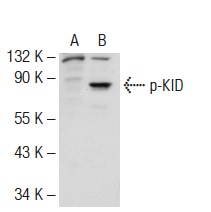
Western blot analysis of KID phosphorylation in non-transfected: (A) and human KID transfected: (B) 293T whole cell lysates.| Product Name | p-KID Antibody (Ser 427) |
|---|---|
| Antibody Type | Primary Antibodies |
| Antigen Alias | epitope corresponding to phosphorylated Ser 427 of KID of human origin |
| Modification | Phosphoralated |
| Modification Notes | Kinesin-like DNA binding protein (KID), also designated kinesin-like protein KIF22, is a member of the kinesin family and is involved in spindle formation. It can bind to microtubules and to DNA and is involved in the regulation of the movement of chromosomes along microtubules during mitosis. KID is a nuclear protein that colocalizes with mitotic chromosomes and the gene maps to chromosome 16p11.2. The gene encoding for KID, KNSL4, spans 16kb and consists of 13 introns and 14 exons. The N-terminal half of KID contains the kinesin-like motor domain, and there is a helix-hairpin-helix DNA binding domain at its C terminus. It has been reported that the subcellular localization of KID changes dramatically during cell division. |
| Clonality | Polyclonal |
|---|---|
| Isotype | IgG |
| Host Species | Rabbit |
| Tested Applications | WBIPIFELISA |
| recommended for detection of Serine 427 phosphorylated KID of mouse, rat and human origin by WB, IP, IF and ELISA also reactive with additional species, including equine, canine, bovine and porcine: |
|
| Species Reactivity | HumanMouseRat |
| Concentration | 1mg/ml |
| Purification | Affinity purified |
| Alternative Names | epitope corresponding to phosphorylated Ser 427 of KID of human origin |
|---|---|
| Tissue Specificity | epitope corresponding to phosphorylated Ser 427 of KID of human origin |
| Entrez Gene | 3835 |
|---|
Application
Western blot analysis of KID phosphorylation in non-transfected: (A) and human KID transfected: (B) 293T whole cell lysates.| Application Notes | recommended for detection of Serine 427 phosphorylated KID of mouse, rat and human origin by WB, IP, IF and ELISA also reactive with additional species, including equine, canine, bovine and porcine: |
|---|
| Form | Liquid |
|---|---|
| Storage Instructions | For short-term storage, store at 4° C. For long-term storage, aliquot and store at -20ºC or below. Avoid multiple freeze-thaw cycles. |
| Storage Buffer | phosphate buffered saline , pH 7.4, 150mM NaCl, 0.02% sodium azide and 50% glycerol. |


